 How-to
How to Maintain Waste Management Vehicle Fleets
Quick Summary
Maintaining waste management fleets means planning for the stop-start wear, hydraulic loads and compacting systems that refuse trucks face daily, not just standard oil changes and tire rotations. Build a daily checklist, set preventive intervals by engine hours, and track downtime and parts.
- Waste trucks need inspections tied to route hours and compactor use, not highway-style schedules.
- Drivers should complete pre-trip and post-trip checklists covering hydraulics, brakes, tires and lights.
- Set service intervals on the higher of engine hours or mileage, since idling wears trucks faster.
- Track repair spending, days out of service and unplanned breakdowns each month.
- Stock parts based on your own repair history, because common failures differ by truck body type.
Table of Contents
- Why Waste Fleets Need a Different Maintenance Approach
- Step 1: Build a Garbage Truck Maintenance Checklist
- Step 2: Set Up Waste Fleet Preventive Maintenance
- Step 3: Schedule Maintenance With Fleet Software
- Step 4: Track Costs and Cut Waste Truck Downtime
- Step 5: Train Technicians and Manage Parts Inventory
- Common Mistakes That Undermine Waste Fleet Maintenance
- Booking Your Next Fleet Inspection With Fairfield Truck Repair
- Frequently Asked Questions
Why Waste Fleets Need a Different Maintenance Approach
Last Updated: October 27, 2026
Waste fleets run harder than most commercial vehicles. A garbage truck may start its day at 5 a.m., stop hundreds of times, and idle while crews empty bins. Maintaining waste management fleets means planning for stop-start wear, hydraulic loads and compacting systems, not just oil changes and tire rotations.
Standard maintenance schedules were written for highway trucks. Waste trucks often sit in the same category, but their wear points are different. Packers, lift arms, and hydraulic lines take abuse every route.
Most waste fleets fall into a reactive pattern. A truck breaks down, it goes to the shop, and the route gets covered by a backup. That cycle is expensive. The fix is a maintenance approach built around the way waste trucks actually work.
- Stop-start duty wears brakes, clutches and transmissions faster
- Hydraulic systems face constant pressure cycles and debris exposure
- Idle time at the curb adds engine hours without covering miles
- Route schedules leave little room for unplanned repairs
A common mistake is copying a highway trucking schedule and calling it done. Waste fleets need inspections tied to route hours and compactor use.
Step 1: Build a Garbage Truck Maintenance Checklist
A garbage truck maintenance checklist gives every driver and technician the same starting point. It should cover the systems that fail most often on refuse vehicles, including brakes, tires, hydraulics, lights, mirrors, and the lift and packing mechanisms.
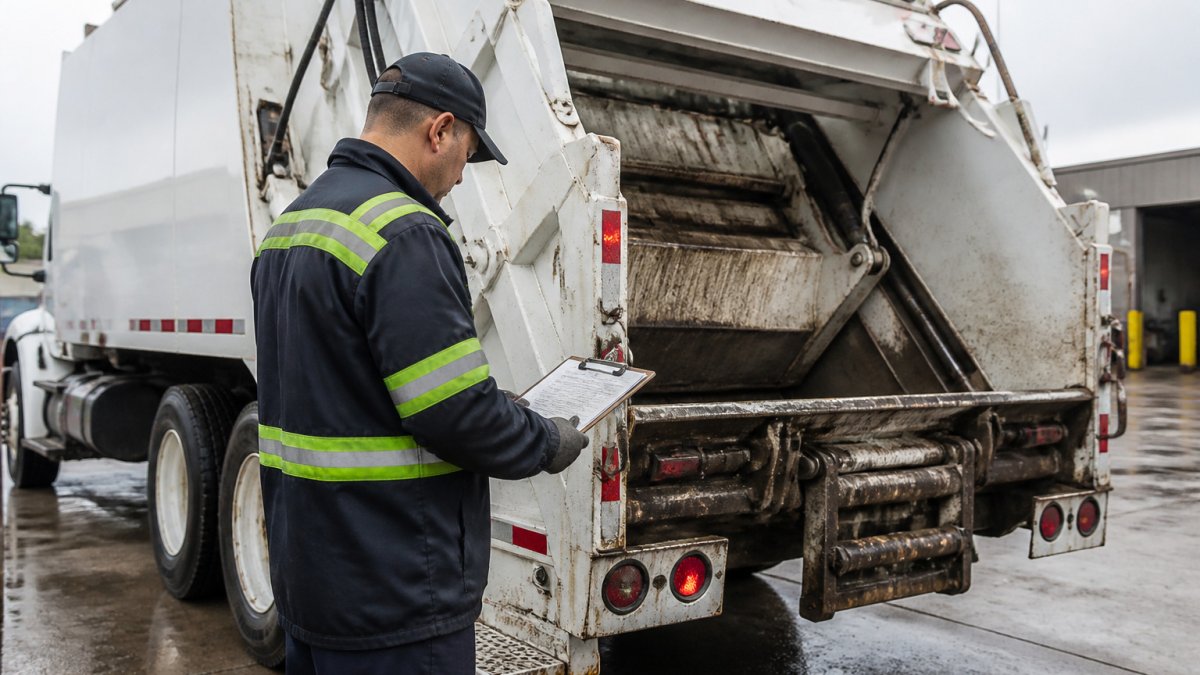
Split the checklist into two parts. The pre-trip inspection happens before the route starts. The post-trip inspection captures problems while the crew is still on site.
Core checklist items:
- Check fluid levels: engine oil, coolant, hydraulic oil, and washer fluid
- Inspect hydraulic hoses and fittings for leaks and abrasion
- Test lift arms, packer blades, and tailgate latches
- Confirm backup alarms, cameras, and warning lights work
- Look at tires for cuts, uneven wear, and proper pressure
- Check brake lines, air tanks, and drum or rotor wear
Watch out: Drivers often skip the hydraulic checks because they seem routine. Leaks found early cost far less than a failed hose during a route.
The checklist only works if it is used. Keep copies in the cab and log completed checks digitally so supervisors can spot patterns.
Step 2: Set Up Waste Fleet Preventive Maintenance
Preventive maintenance is the core of any solid program for maintaining waste management fleets. The goal is to catch small problems before they become breakdowns that take a truck off the route.
Start by setting intervals based on engine hours and miles, not just calendar time. A truck that idles through three shifts a day needs service sooner than its odometer suggests.
Many fleet managers find that a structured program pays off. For a deeper look at why these programs make financial sense, read Benefits of Preventive Fleet Maintenance Programs.
A practical preventive schedule includes:
- Daily pre- and post-trip inspections by drivers
- Weekly hydraulic fluid and filter checks
- Monthly brake, tire, and lighting reviews
- Quarterly full inspections with compressed-air and battery testing
- Annual major service on engines, transmissions, and drivelines
Expected result: Fewer emergency repairs and more predictable service costs within the first few months of consistent scheduling.
Step 3: Schedule Maintenance With Fleet Software
Fleet maintenance scheduling software helps track service intervals, repair orders, and warranty deadlines in one place. For waste fleets with dozens of trucks, paper logs quickly fall behind. But software only creates value when it is configured around the way refuse trucks actually accumulate wear: engine hours, idle time, compaction cycles, and route assignments.
Configure intervals around engine hours, not just odometer miles. Set service triggers on the higher of engine hours or mileage, and use telematics feeds to push that data into the maintenance module automatically.
Link driver inspection reports directly to work orders. The pre-trip and post-trip checklists from Step 1 should feed the same system that generates repair orders. This closes the loop that most paper-based programs lose.
Build the data fields that matter for waste trucks. Generic fleet software tracks VIN, mileage, and repair date. Waste-specific configuration should also capture:
- Truck body type (rear-loader, front-loader, side-loader, roll-off) and compactor model
- Route assignment and average stops per shift
- Hydraulic system service history, including hose and pump replacements
- Lift arm and packer blade inspection results
- Engine-hour readings at each service event
Those fields let you spot patterns, for example, that front-loaders on dense commercial routes are eating brake linings faster than rear-loaders on residential routes.
Keep inspection records audit-ready. Compliance matters beyond internal scheduling. Maintenance software should store completed inspection forms, repair histories, and parts records in a format you can produce during a roadside inspection or a safety audit. The software is what makes retrieval fast.
Track parts usage by truck model. When the same hose or seal fails repeatedly on one make and model, the software should surface that pattern so you can adjust inventory and preventive intervals. This is the bridge to the parts management discussion in Step 5.
The key is consistency. A tool only helps when drivers and technicians log work the same way every time, and when the data fields are built for refuse equipment rather than highway tractors.
Step 4: Track Costs and Cut Waste Truck Downtime
Waste truck downtime is expensive. Every idle truck means overtime for backup drivers, rerouted collections, and possible missed pickups that frustrate customers. Tracking downtime alongside repair costs shows where your program is working and where it is not.
Measure three numbers each month: total repair spending per truck, days out of service, and the number of unplanned breakdowns. These numbers reveal which trucks need replacement and which need better preventive care.
Ways to reduce downtime:
- Keep a spare-parts stock for the most common failures on your fleet
- Schedule repairs during off-route hours or between shifts
- Track repeat repairs and investigate root causes
- Build relationships with a shop that can respond fast when a truck fails
Here is where many programs stall. Managers track repair bills but ignore the cost of a truck sitting in the yard. Include downtime in your budget review and the case for preventive care becomes much clearer.
Tracking these three monthly numbers shows where your program is working and where it is not.
| Metric | What to track | Why it matters |
|---|---|---|
| Repair spending | Total repair cost per truck | Shows which trucks cost the most |
| Days out of service | Days each truck sits idle | Reveals the cost of downtime |
| Unplanned breakdowns | Count of unexpected failures | Signals where preventive care falls short |
Step 5: Train Technicians and Manage Parts Inventory
Most maintenance content focuses on software and schedules. The harder problem is human and physical: finding technicians who can diagnose hydraulic and diesel systems on refuse equipment, keeping them, and having the right parts on the shelf when a truck fails. This is where many waste fleets quietly lose uptime.
Technician training and retention. Waste fleet maintenance requires skills that general automotive programs do not teach: hydraulic diagnostics on packer and lift systems, diesel engine and emissions repair, electronic control module troubleshooting, and air brake service. For a detailed walkthrough of diesel engine repair on refuse trucks, see the diesel engine repair guide for waste trucks. Losing an experienced technician can slow repairs for months because the replacement needs both general diesel skills and equipment-specific knowledge.
A practical training structure includes:
- Manufacturer training. Truck body and compactor manufacturers offer service training on their specific equipment. Send at least one technician per body type so the fleet is not dependent on a single person.
- Cross-training. Pair experienced technicians with newer hires on hydraulic and electrical diagnostics so knowledge does not leave with one retirement.
- Documented procedures. Write down the diagnostic steps for common failures, packer blade drift, lift arm hesitation, hydraulic hose failure, so a less experienced technician can follow a known path instead of starting from scratch.
- Retention basics. Predictable schedules, clean shop equipment, and a clear path to advanced certification matter more than most managers assume. Technicians leave shops where they are set up to fail.
Parts inventory management. Supply chain challenges for heavy-duty waste vehicle parts are rarely discussed in depth, but they are a real source of downtime. Hoses, seals, filters, brake components, and hydraulic pumps for refuse equipment are not always stocked at local parts counters, and a special-order part can add days to a repair.
A working inventory approach:
- Classify parts by criticality. A failed hydraulic hose can sideline a truck; a failed mirror cover cannot. Stock critical parts to a defined reorder point and order non-critical parts as needed.
- Track usage by truck model. Hoses, filters, brake pads, and seals fail at different rates on different body types and routes. Review usage quarterly and adjust stock levels accordingly.
- Set reorder points, not just minimums. A reorder point triggers a purchase before the shelf is empty, accounting for lead time. For parts with long lead times, the reorder point should be higher.
- Negotiate with suppliers on the high-volume items. Filters, hydraulic oil, and brake components are predictable purchases. Volume agreements reduce cost and improve availability.
- Keep a record of which parts fail on specific truck makes. This feeds both inventory decisions and preventive maintenance intervals.
The takeaway: software and schedules only work if the shop has the people and parts to execute them. Treat technician development and parts inventory as core maintenance functions, not back-office afterthoughts.
Common Mistakes That Undermine Waste Fleet Maintenance
Even well-funded programs fail in predictable ways. Knowing the common traps helps you avoid them.
- Ignoring driver reports. Drivers see problems first. Make it easy for them to report issues and act on what they report.
- Treating all trucks the same. Compactor models, route lengths, and age all change service needs.
- Delaying hydraulic repairs. Small leaks often lead to pump failures and costly downtime.
- Relying only on mileage. Engine hours and compaction cycles matter more for waste trucks.
- Skipping records. Without history, you cannot tell which repairs actually solved the problem.
A common mistake is treating maintenance as a cost to minimize rather than an investment in uptime. Programs that cut service too deeply usually pay more later.
Booking Your Next Fleet Inspection With Fairfield Truck Repair
If your waste fleet is overdue for an inspection, now is the time to schedule one. You can book DOT inspections with Fairfield Truck Repair to get compliant checks on your trucks. Our Heavy Duty Truck Repair team handles repairs.
Fairfield Truck Repair offers comprehensive fleet maintenance. Contact us to discuss your fleet's maintenance needs.
Frequently Asked Questions
How often should waste management trucks be serviced?
Check the manufacturer's recommendations for your chassis and body, then adjust based on your actual duty cycle and the failures you record.
What should a waste collection truck inspection include?
A solid inspection covers brakes, tires, lights, mirrors, steering, and the hydraulic system that drives the lift arms and packer blade. Technicians should check hydraulic hoses for leaks and wear, confirm the packer and lift mechanisms cycle correctly, and inspect the body for cracks or loose mounts. Document every finding on a repair order so trends show up over time. Pre-trip and post-trip driver inspections catch problems between scheduled services.
How can preventive maintenance reduce fleet downtime?
Tracking unplanned downtime against scheduled service shows where your program is working and where it needs more attention.