 How-to
How Construction Fleets Minimize Vehicle Downtime
Last Updated: November 21, 2026
Quick Summary
Construction fleets minimize vehicle downtime by tying preventive maintenance to engine hours and duty cycle, triaging repairs by safety and schedule impact, and pre-planning replacement capacity. Tracking unplanned downtime, availability, MTTR and MTBF by asset class shows whether downtime is actually falling.
- Log engine hours and idle hours for every unit for 30 days before setting service intervals.
- Rank repairs in three tiers by safety and schedule impact, and fix Tier 1 items now.
- Include tow time, parts wait and authorization delay in the repair clock, not just wrench time.
- Set a replacement threshold per asset class so spares or rentals activate before diagnosis finishes.
- Track response time and repair turnaround per vendor quarterly and drop providers whose turnaround worsens.
Table of Contents
- Why Vehicle Downtime Hits Construction Fleets Harder Than Anyone Else
- Build a Fleet Preventive Maintenance Schedule That Actually Gets Followed
- The Vehicle Maintenance Checklist for Fleet Managers Who Run Mixed Assets
- Prioritizing Repairs Across a Mixed Construction Fleet
- Fleet Maintenance Software and Telematics: What Data Actually Prevents Failures
- Fleet Maintenance KPIs That Show Whether Downtime Is Really Falling
- Contingency Planning for Breakdowns, Jobsites, and Seasonal Conditions
- Setting Up a Maintenance and Repair Program With Fairfield Truck Repair
- Frequently Asked Questions
Why Vehicle Downtime Hits Construction Fleets Harder Than Anyone Else
A down truck on a construction site does more than stall one delivery.
Vehicle downtime is the total time an asset sits unusable, from the moment it fails until it is back in service.
That is why minimized vehicle downtime for construction fleets is a scheduling problem as much as a mechanical one.
The core tension: most fleets treat downtime as a repair cost.
Build a Fleet Preventive Maintenance Schedule That Actually Gets Followed
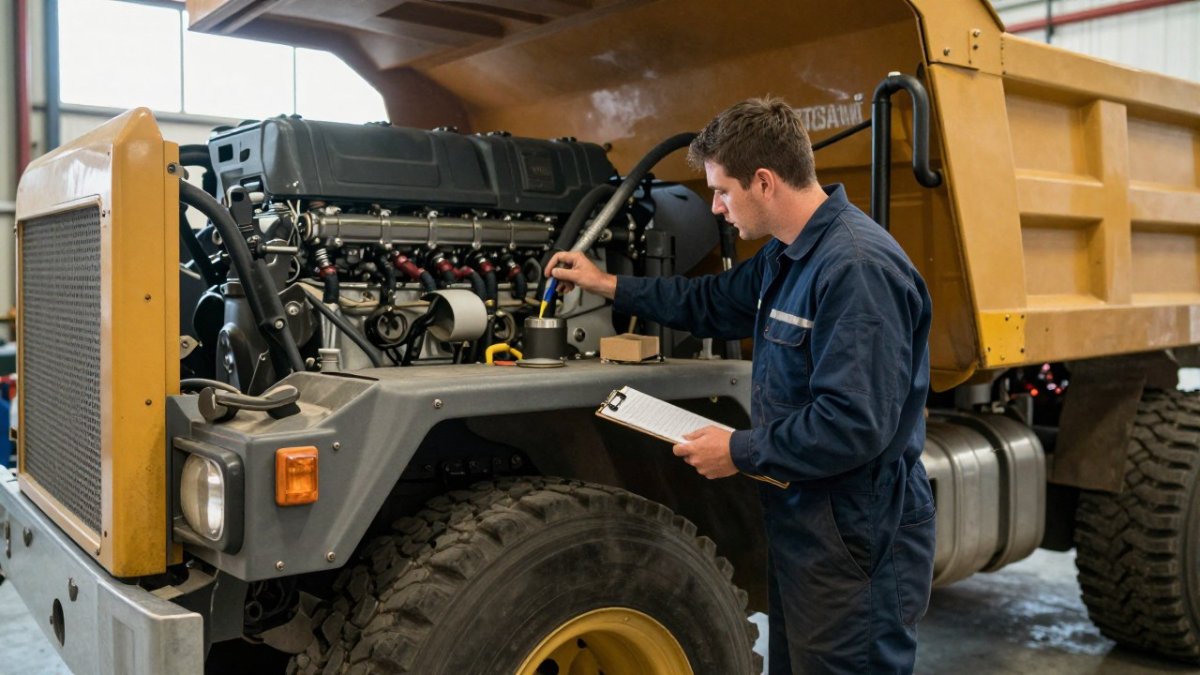
A fleet preventive maintenance schedule works when it is tied to engine hours and duty cycle, not just calendar dates.
Start with these steps:
- Log engine hours and idle hours for every unit for 30 days
- Set service intervals by duty cycle, not by odometer alone
- Assign one person to own the schedule and the follow-up
If you want the full case for proactive maintenance before committing, read our breakdown of the benefits of preventive fleet maintenance programs.
A common mistake is building a schedule nobody enforces. If the schedule lives in a spreadsheet only one person opens, it will fail within a quarter.
The Vehicle Maintenance Checklist for Fleet Managers Who Run Mixed Assets
A vehicle maintenance checklist for fleet managers has to flex across asset types. A pickup, a dump truck, and a skid steer do not share the same failure points, and one generic list will miss all three.
Daily driver checks:
- Fluid levels and visible leaks
- Tire condition and pressure
- Lights, signals, and backup alarms
Weekly shop checks:
- Belt and hose condition
- Battery terminals and hold-downs
- Hydraulic lines on equipment
Pre-trip and post-trip inspections catch most small failures before they become breakdowns. The driver is your cheapest diagnostic tool. Train them to report, not to ignore.
Prioritizing Repairs Across a Mixed Construction Fleet
Not every repair deserves the same urgency. Rank each open item by two factors: safety and schedule impact. A brake fault on a crew hauler outranks a cosmetic issue on a spare trailer every time.
A simple triage method:
- Tier 1: Safety-critical or blocks a scheduled crew. Fix now.
- Tier 2: Will fail soon and has no backup unit. Schedule within days.
- Tier 3: Cosmetic or on a unit with a spare. Batch it.
What most guides miss is the backup question. A repair on a unit with no replacement is a Tier 1 problem even if the fault is minor. Availability drives the ranking, not just severity.
Fleet Maintenance Software and Telematics: What Data Actually Prevents Failures
Fleet maintenance software earns its keep when it turns fault codes and engine data into action. Telematics that only report location are a tracking tool, not a maintenance tool.
The data that actually prevents failures:
- Diagnostic alerts tied to specific fault codes
- Engine hour and idle time trends per unit
- Repeat-failure history on the same component
Software does not fix trucks. It tells you which truck to look at first.
Fleet Maintenance KPIs That Show Whether Downtime Is Really Falling
Most fleet KPI lists stop at a dashboard screenshot. For construction, the useful question is narrower: which asset classes are eating schedule, and is the trend getting better or worse? That requires defining downtime precisely before you measure it.
Start by separating the two clocks. Planned downtime is time an asset is intentionally out of service, scheduled PM, inspections, tire swaps, planned component replacement. Unplanned downtime is everything from the moment of failure or fault detection until the unit is returned to dispatch-ready condition. Only unplanned downtime belongs in the number you are trying to cut; mixing the two hides whether your PM program is working.
The four calculations that matter
Run these by vehicle class, pickup, dump truck, mixer, trailer, skid steer, excavator, not as one fleet-wide average. A single blended number lets a healthy pickup fleet mask a failing mixer fleet.
- Downtime rate = unplanned downtime hours ÷ total scheduled operating hours, per unit and per class. Track it monthly.
- Availability rate = (scheduled hours − unplanned downtime hours) ÷ scheduled hours. This is the capacity number your dispatcher actually feels.
- Mean time to repair (MTTR) = total repair clock hours ÷ number of repair events. Define the clock explicitly: from the time the failure is reported to the time the unit is released, not from when the tech touches it. Otherwise you measure wrench time, not fleet performance.
A common pattern is to compute MTTR only for in-shop repairs and then wonder why roadside events dominate the loss. Include tow time, parts wait, and authorization delay in the repair clock, those are the phases a fleet manager can actually shorten.
Construction-specific cuts competitors skip
- By job criticality, not just asset class. A backup trailer and a primary crew hauler are both trailers; only one belongs in the headline availability number. Report availability separately for Tier 1 assets (see the prioritization section).
- By failure phase. Split unplanned downtime into detection-to-dispatch, dispatch-to-arrival, diagnosis, parts wait, repair, and return-to-service. Most fleets find parts wait and authorization delay are larger than wrench time.
- By season. Winter cold-start and hydraulic failures and summer cooling and tire failures produce different MTBF curves. A 12-month average hides both.
A simple tracking cadence
| Cadence | What to review | Decision it drives |
|---|---|---|
| Weekly | Open Tier 1 repairs, MTTR on active events | Escalate stalled repairs, authorize parts |
| Monthly | Downtime rate and availability by class | Adjust PM intervals, shift spare capacity |
| Quarterly | MTBF by component family, parts-wait trend | Change vendor terms, stock critical parts |
A KPI reviewed only at quarter-end is closer to a post-mortem than a control.
One bad month is noise. Three consecutive months of rising unplanned downtime in a single asset class is a signal to change intervals, vendor, or replacement capacity, not to add another dashboard.
Contingency Planning for Breakdowns, Jobsites, and Seasonal Conditions
A contingency plan is not a phone number on a clipboard. It is a decision tree that tells a dispatcher, a foreman, and a shop lead what to do in the first hour, and a set of pre-negotiated capacities that make the second hour cheaper.
Layer 1: The first-hour response workflow
Write this down and post it in the dispatch office and each foreman's truck:
- Report, driver or operator calls a single dispatch number, not the shop, not the foreman, not both. Log unit number, location, symptom, and whether the unit is blocking a pour, a haul route, or a lane.
- Triage, dispatcher classifies the event using the same Tier 1/2/3 ranking used for open repairs. Safety-critical or schedule-blocking events go to Tier 1 immediately.
- Authorize, one named person per shift can approve roadside service and towing up to a pre-set limit without further sign-off. Delayed authorization is one of the largest hidden components of MTTR.
- Dispatch, call the pre-vetted roadside provider for that corridor, not a general search result at 2 a.m.
- Replace, if the unit is Tier 1 and the repair will exceed the replacement threshold, activate the spare or rental before the diagnosis is finished, not after.
Watch out: if the first-hour workflow requires a manager who is asleep, it will fail on the night shift, which is when a disproportionate share of construction breakdowns happen.
Layer 2: Replacement capacity, decided in advance
Replacement capacity is where most construction fleets under-plan. Decide three things before the season starts:
- Spare units. Identify which asset classes justify a dedicated spare. A spare only pays for itself if the asset is Tier 1 and the rental lead time exceeds the repair time. For low-utilization classes, a rental agreement is cheaper than a parked spare.
- Rental relationships. Establish accounts with two rental sources per region, confirm delivery lead times in writing, and confirm whether the rental yard can deliver to a remote jobsite and at what hour. A rental that arrives at 9 a.m. does not save a 6 a.m. pour.
- Equipment sharing. For multi-crew operations, define which units can be borrowed across jobs and who authorizes it. Informal borrowing is how a Tier 2 repair becomes a Tier 1 failure on another site.
Set a replacement threshold per asset class: the repair duration above which you activate replacement instead of waiting. For a primary crew hauler, that threshold may be a few hours; for a low-criticality trailer, it may be days. The threshold is a management decision, not a shop decision.
Layer 3: Jobsite and seasonal conditions
Dust, mud, extreme heat, and cold change failure modes, and remote sites change response times. Adjust the plan, not just the inspection checklist:
- Dust and mud. Shorten air filter, grease, and hydraulic inspection intervals during grading and earthmoving peaks. Mud accelerates brake and undercarriage wear; dust accelerates filter loading and cooling-system fouling.
- Heat. Cooling-system, tire, and hydraulic-hose failures rise in summer. Pre-season checks on coolant condition, fan drives, and hose condition reduce peak-season events.
- Cold. Battery, fuel gelling, and air-system moisture problems dominate winter. Cold-start procedures and battery load testing before the first freeze prevent a predictable cluster of failures.
Layer 4: Vendor performance and repair turnaround
A contingency plan is only as good as the vendors in it. Track two numbers per service provider: response time (call to arrival) and repair turnaround (arrival to release).
When a truck dies at 2 a.m. on a highway shoulder, the plan is what you execute. Have a roadside and emergency service number saved and confirmed, and compare roadside service options before you need them, not after.
Setting Up a Maintenance and Repair Program With Fairfield Truck Repair
A repair program only reduces downtime when the shop and the fleet manager share the same schedule and the same records. That is the part most fleets skip.
A repair program is typically set up as follows:
If you are weighing a switch, our guide on choosing a reliable fleet maintenance partner covers the questions to ask. When you are ready to formalize the program, you can start fleet maintenance service with a team that runs heavy-duty diesel diagnostics and roadside support.
Downtime is not a repair bill. It is idle crews, missed pours, and penalties that compound. Fairfield Truck Repair builds maintenance programs around your duty cycles, backs them with specialized diesel diagnostics, and keeps roadside service ready when a unit fails anyway.
Frequently Asked Questions
What are the biggest causes of vehicle downtime in construction fleets?
Most unplanned downtime traces back to a handful of sources: deferred preventive maintenance, worn brakes and tires on heavy equipment, battery and electrical failures in cold weather, and parts that are not on hand when a repair starts. Jobsite conditions make it worse, since dust, mud, and constant load cycles wear components faster than highway miles do. The practical fix is a maintenance schedule tied to engine hours and duty cycle, not just odometer readings, plus a stock of the fast-moving parts your trucks actually consume.
How can a fleet preventive maintenance schedule reduce repair costs?
A fleet preventive maintenance schedule moves work from emergency repairs to planned service, which is cheaper on two fronts. Planned service can be batched, scheduled around project phases, and priced before it happens. Breakdowns cannot. Catching a worn brake pad or a leaking seal during an inspection also stops a small part from turning into a seized component or a roadside tow. Track your repair costs before and after you formalize the schedule so you can see the difference in your own numbers rather than guessing.
Which fleet maintenance KPIs should a construction operation track first?
Start with four: vehicle availability rate (the share of the fleet ready for dispatch), mean time to repair, maintenance compliance rate (scheduled services completed on time), and unplanned downtime hours per vehicle per month. These four tell you whether trucks are ready, how fast they come back, whether your program is being followed, and how much time you are actually losing. Add cost per mile or cost per engine hour once the basics are stable. Review the numbers monthly with your service provider so trends are visible.
Can telematics and fleet maintenance software really prevent breakdowns?
They prevent some and shorten others. Diagnostic alerts from telematics can flag a fault code before a truck fails on the road, and fault-code history gives your shop a head start on diagnosis. Fleet maintenance software handles the scheduling side: service intervals by engine hours, inspection records, and parts history in one place. Neither replaces inspections or a good technician. The value comes from acting on the alerts quickly, which means agreeing in advance who reviews them and how fast a flagged truck gets pulled from service.