 How-to
7 Steps to Choose a Semi Truck Service Center Near Me
Last Updated: November 19, 2026
Quick Summary
A semi truck service center is a facility staffed by diesel technicians and equipped to diagnose and repair heavy-duty trucks, trailers, and related systems, from engines and air brakes to electrical faults and tires. Choose one by matching its capabilities to your repair type, confirming after-hours availability, and getting a written estimate before work begins.
- Ask whether technicians are certified on heavy-duty diesel systems and can show it.
- Do not drive a truck with a brake fault, heavy fluid leak, or speed-limiting derate; dispatch mobile service or towing.
- Get the number, parts, and warranty in writing before the truck goes into the bay.
- Build your fleet maintenance plan around service intervals, not calendar dates alone.
- A shop that can't explain its diagnostic process in plain language is telling you something.
Table of Contents
- What to Check Before You Pick a Semi Truck Service Center Near Me
- Step 1: Match the Shop's Capabilities to Your Repair Type
- Step 2: Decide Between a Shop Visit and Mobile Repair
- Step 3: Confirm 24 Hour Semi Truck Service Center Near Me Availability
- Step 4: Understand Semi Truck Service Cost and Estimate Expectations
- Step 5: Build a Semi Truck Fleet Maintenance Plan That Cuts Downtime
- Step 6: Run a Breakdown Response Checklist Before You Need It
- Step 7: Ask the Questions That Separate a Real Shop From a Parts Swapper
- Frequently Asked Questions
What to Check Before You Pick a Semi Truck Service Center Near Me
Searching for a semi truck service center near me usually happens at the worst possible moment: a check-engine light, a soft brake pedal, or a truck that won't build air pressure. At Fairfield Truck Repair, we see the results of rushed choices every week, and the pattern is consistent.
A semi truck service center is a facility staffed by diesel technicians and equipped to diagnose and repair heavy-duty trucks, trailers, and related systems, from engines and air brakes to electrical faults and tires. The right one combines certified technicians, the right diagnostic equipment, and a clear estimate process.
Proximity matters when you're broken down, but capability matters every other day of the year. Below, we walk through the steps that help separate a shop worth a long-term relationship from one that just swaps parts until the light goes off.
Verify Certifications, Warranties, and Parts Policies
Start with paperwork, not pricing. Ask which certifications the technicians hold and whether the shop provides written estimates and warranties on parts and labor. The Federal Motor Carrier Safety Administration's maintenance guidance is a useful reference for what compliant maintenance records should look like, since your shop's documentation feeds directly into your own inspection readiness.
Three questions cut through the sales talk:
- Are technicians certified on heavy-duty diesel systems, and can they show it?
- Is there a written warranty on parts and labor, and how long does it run?
- Do you use OEM or aftermarket replacement parts, and will you tell me which before installing?
A common mistake is accepting a verbal assurance without written terms. Get warranty details on the invoice.
Step 1: Match the Shop's Capabilities to Your Repair Type
Capability fit is the single biggest predictor of a good outcome. A shop that excels at tire service may not have the diagnostic depth for a diesel aftertreatment fault. Map your repair to the shop's actual equipment before you commit.
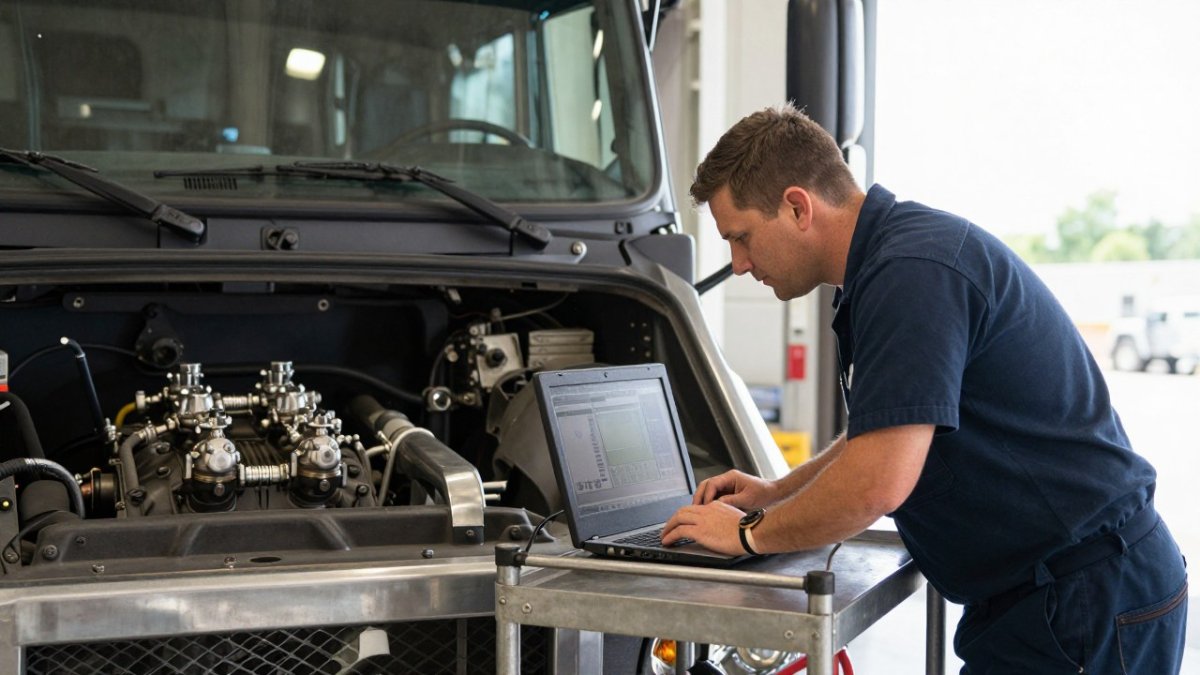
Match the job to the specialty:
- Engine and diagnostics: look for computerized engine diagnostics, injector testing, and aftertreatment service.
- Brakes: air brake repair, slack adjuster work, and DOT brake inspection capability.
- Electrical: starting, charging, lighting, and trailer wiring diagnosis.
- Trailer repair: landing gear, doors, suspension, and reefer work if you run temperature-controlled freight.
- Tires: dual assembly service, alignment, and road hazard repair.
Step 2: Decide Between a Shop Visit and Mobile Repair
The shop-versus-mobile decision comes down to three questions, in this order: can the truck move safely, does the repair need a lift or a bay, and how much diagnostic depth does the fault require. Answer them in that sequence and the choice usually makes itself.
First, roadworthiness. If the truck won't build air pressure, has a brake fault, is leaking fluid heavily, has a steering or suspension problem, or is throwing a derate that limits speed, do not drive it. Dispatch mobile service or towing.
Second, equipment fit.
Third, diagnostic depth. A fault code that points to a sensor or a wiring harness is often a mobile fix. A fault code that points to an injector, a turbo, or an internal engine problem usually needs the shop's diagnostic software and the ability to run the engine under load. Ask the dispatcher which category your symptom falls into before you authorize a mobile call, because a mobile technician who arrives and finds the job needs a bay has cost you the call-out fee and the wait.
Weighing cost and downtime? Mobile service usually wins on downtime because the truck never leaves your location, but it can lose on total cost when the same job would have been finished faster in a bay. A shop visit usually wins on thoroughness because the technician can inspect related systems while the truck is on the lift. Our breakdown of mobile truck repair versus shop service compares cost, downtime, and which repairs each option actually handles.
Watch out: a brake or air-pressure fault should be treated as a safety concern before deciding whether a truck can keep moving.
Step 3: Confirm 24 Hour Semi Truck Service Center Near Me Availability
Confirm emergency availability before you need it, and ask what response time looks like for your typical routes.
When evaluating after-hours availability, ask whether the shop has a live after-hours phone line, on-call technicians, and a stated coverage area.
When a truck is down on the shoulder, speed matters. Our roadside and emergency service can help with breakdowns on the road.
Step 4: Understand Semi Truck Service Cost and Estimate Expectations
Semi truck service cost depends on the repair, the parts used, and the labor involved. Ask for a written estimate before work begins and confirm pricing details directly with Fairfield Truck Repair or request a quote through our website.
What drives the bill. Several factors affect the total, including diagnostic time, the parts used, labor, and when the work is performed. Ask Fairfield Truck Repair how each of these applies to your repair.
What to confirm before you authorize work. Ask these questions up front and write the answers down:
- Is there a diagnostic fee, and does it apply toward the repair if you proceed?
- What is the shop's labor rate, and is it different for after-hours or mobile calls?
- Will you call me before adding work beyond the estimate, and what is the threshold?
- Are core charges, shop supplies, and disposal fees itemized separately?
- What is the warranty on parts and on labor, and does it cover a return visit for the same fault?
What a written estimate should contain. Ask for an estimate that lists the diagnosis, the recommended repair, the parts, the labor, and the total, along with what happens if additional problems are found during repair.
Where drivers get surprised. Unexpected charges often come from details that were not discussed up front. The fix is asking before the work starts.
For a fuller picture of how repair bills break down, our heavy-duty maintenance pricing guide walks through what drives cost on common jobs. The principle is simple: a shop that explains its estimate process clearly is usually a shop that bills fairly.
Watch out: a verbal estimate can be hard to verify. Get the number, the parts, and the warranty in writing before the truck goes into the bay.
Step 5: Build a Semi Truck Fleet Maintenance Plan That Cuts Downtime
Preventive maintenance is cheaper than emergency repair, and the math is straightforward: a scheduled brake inspection costs a fraction of a roadside brake job plus lost revenue. A semi truck fleet maintenance plan moves work from "urgent" to "planned."
Build the plan around service intervals, not calendar dates alone:
- DOT annual inspection and brake adjustment checks
- Oil and filter service by mileage and engine hours
- Coolant, air dryer, and fuel filter replacement on schedule
- Tire rotation, alignment, and tread depth tracking
- Aftertreatment and DPF inspection
If you'd rather hand the schedule to a shop that tracks it for you, our fleet maintenance program covers preventive care built to keep trucks road-ready. The goal isn't more shop visits. It's fewer surprise ones.
| Maintenance Item | Typical Interval | Downtime If Deferred |
|---|---|---|
| Brake inspection and adjustment | Every 25,000 miles | Roadside out-of-service |
| Oil and filter service | By mileage or engine hours | Premature engine wear |
| Air dryer service | Annually or by schedule | Air system failure |
| Tire and alignment check | Every other service | Irregular wear, blowouts |
| DOT annual inspection | Every 12 months | Compliance violation |
Step 6: Run a Breakdown Response Checklist Before You Need It
A breakdown checklist turns a 2 AM panic into a fifteen-minute process. Print it, put it in every truck, and make sure dispatch has a copy.
- Pull to a safe location and set triangles and hazards
- Note the symptom: warning lights, air pressure reading, unusual noises
- Photograph the dash, the fault code, and the damage
- Call the shop's after-hours line and describe the symptom precisely
- Confirm whether the truck is drivable or needs a tow
- Record the dispatcher's name and estimated arrival window
- Notify your customer or broker of the delay immediately
The thing nobody tells you about breakdowns is that the quality of your first phone call determines the speed of the fix. A technician who knows the fault code and the symptom before rolling saves diagnostic time on the shoulder.
Step 7: Ask the Questions That Separate a Real Shop From a Parts Swapper
The final filter is a conversation. A shop that diagnoses before replacing earns repeat business. A parts swapper guesses and bills you for the guess.
Ask these directly:
- How do you diagnose a fault before replacing parts?
- Can I see the old parts after the repair?
- What happens if the same problem returns within the warranty period?
- Who works on my truck, and what's their experience with my equipment type?
Watch out: a shop that can't explain its diagnostic process in plain language is telling you something. So is one that dodges the warranty question.
Once you've narrowed the field, contact our team with your questions before you hand over the keys.
Finding a semi truck service center that diagnoses correctly, quotes honestly, and answers at 2 AM is the difference between a fleet that runs and a fleet that limps. Fairfield Truck Repair pairs specialized diesel diagnostics with comprehensive fleet maintenance and roadside service, all aimed at one outcome: minimized vehicle downtime for heavy-duty fleets. Get started with Fairfield Truck Repair and keep your trucks on the road, not in the queue.
Frequently Asked Questions
How much does a semi truck service cost?
Semi truck service cost depends on the repair type, parts needed, and labor hours, so no single figure covers every job. A routine oil and filter service costs far less than engine diagnostics or air-brake repair. Ask for a written estimate before work begins and confirm whether the shop charges diagnostic time separately.
When should I use mobile semi truck repair instead of driving to a shop?
Choose mobile repair when the truck cannot safely move, when a breakdown blocks a lane or loading dock, or when the fix is a known roadside job such as a tire, battery, air line, or electrical fault. Drive to the shop for diagnostics, engine work, brake service, and anything needing a lift or specialized equipment.
Can a semi truck service center handle fleet maintenance for a small operation?
Ask whether a shop's fleet maintenance programs suit operations of your size. Ask how the shop handles emergency calls when regular technicians are booked, and get the answer in writing.
What should I ask a truck repair shop before booking service?
Ask about technician certifications, warranty terms on parts and labor, whether they use OEM or aftermarket parts, and how estimates are handled if the diagnosis changes mid-repair. Confirm service hours, emergency availability, and response times for roadside calls. Also ask whether they have worked on your equipment type, since waste haulers, box trucks, and long-haul tractors each bring different demands.