comparison
Mobile Truck Repair vs Shop Service: Which Saves More?
Last Updated: October 24, 2026
Quick Summary
Mobile truck repair vs shop service each solve the same problem differently: mobile service gets you back on the road faster for simple fixes at your location, while shop service handles complex repairs that require lifts and specialized equipment. The choice depends on repair complexity, downtime cost, and whether the truck can be safely fixed roadside or needs a shop bay.
- Mobile labor rates run higher per hour, but shop service usually costs less overall for planned maintenance since there's no dispatch fee or travel time.
- Downtime cost per day is the single number that most often decides whether mobile service is cheaper overall for breakdowns.
- Mobile technicians can diagnose and fix roadside issues like no-starts, tire failures, fuel filter problems, and electrical faults within 30 minutes to 2 hours.
- Major repairs like engine overhauls, transmission rebuilds, and structural welding cannot be done safely roadside and require shop equipment.
- Most fleets need both: mobile service for emergencies and preventive maintenance on-site, plus shop service for complex diagnostics and major overhauls.
Table of Contents
- Mobile Truck Repair vs Shop Service: Key Differences
- Comparison Table: Mobile vs Shop Repair at a Glance
- Mobile Truck Repair Cost: What You Actually Pay
- Mobile Truck Repair vs Towing: The Hidden Economics
- Heavy-Duty Truck Diagnostics: Mobile Capabilities and Limits
- On-Site Fleet Maintenance: When Mobile Service Works Best
- Repair Types That Demand Shop Equipment vs Roadside Service
- Building Your Fleet Repair Strategy: Decision Framework
- Frequently Asked Questions
Mobile Truck Repair vs Shop Service: Key Differences
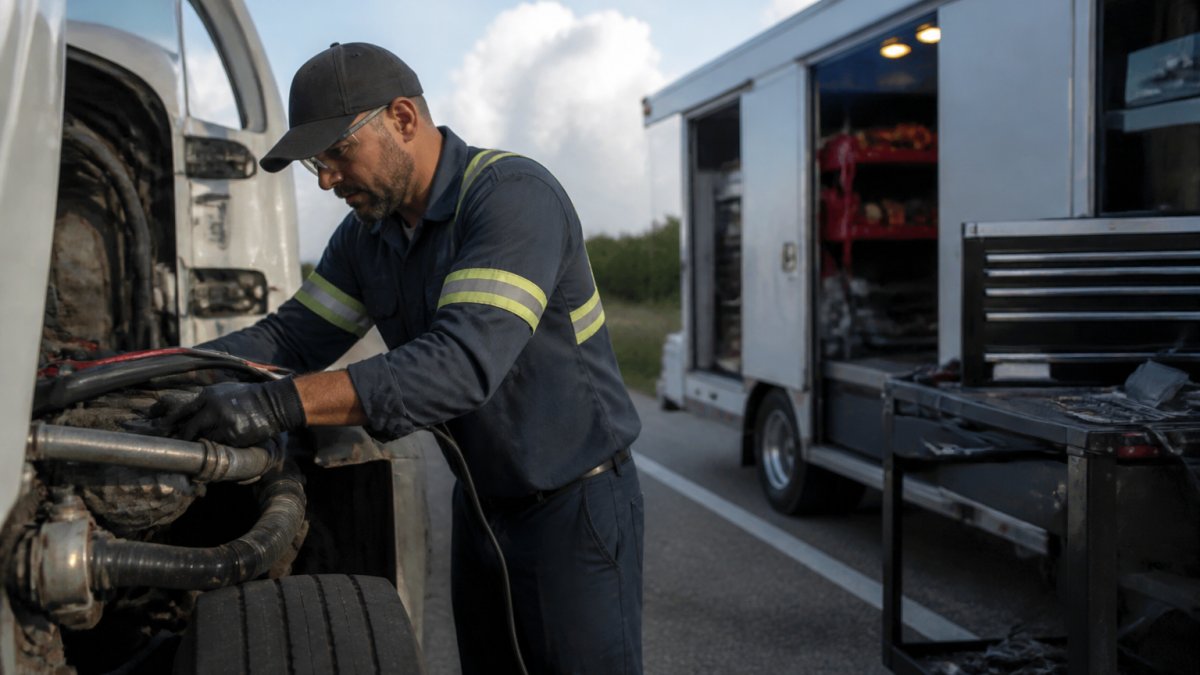
Mobile truck repair and shop service solve the same problem differently. Roadside & Emergency Service provides fast assistance for breakdowns and urgent repairs at your location.
The core trade-off is convenience versus capability: mobile service gets you back on the road faster for simple fixes, shop service handles what mobile technicians can't do safely.
Comparison Table: Mobile vs Shop Repair at a Glance
| Aspect | Mobile Truck Repair | Shop Service |
|---|---|---|
| Response Time | 30 minutes to 2 hours | 1-3 days (scheduling) |
| Towing Cost | Avoided | $150-$500+ |
| Downtime | Minimal (often same-day) | 1-5 days typical |
| Equipment Available | Basic hand tools, diagnostics | Full lifts, specialized rigs |
| Best For | Roadside breakdowns, simple fixes | Major overhauls, complex diagnostics |
| Repair Complexity | Basic to moderate | Any complexity |
| Cost per Hour | Higher labor rate | Lower labor rate |
| Warranty Follow-up | Limited | Full shop support |
Mobile Truck Repair Cost: What You Actually Pay
Mobile labor rates typically run higher than shop rates.
Compare total cost of repair for each path, mobile dispatch versus tow-plus-shop, since several line items are easy to overlook.
Line items that belong in a mobile-service estimate:
- Mobile labor rate (usually billed portal-to-portal, meaning travel time counts)
- Dispatch or call-out fee, often a flat charge on top of labor
- After-hours, weekend, or holiday premium
Line items that belong in a tow-plus-shop estimate:
- Towing or heavy-duty recovery, which scales with distance, truck weight, and whether a heavy wrecker is required
- Shop diagnostic fee
- Shop labor rate (lower per hour, but the clock starts when the truck is on the bay, not when it breaks down)
Downtime is the item that flips the math. It isn't a repair expense, but it's real and usually larger than the difference between the two labor rates.
A common pattern: a truck breaks down with a no-start or derate. The mobile technician arrives, bills a dispatch fee plus portal-to-portal labor, and either fixes it on-site (total: the mobile invoice, downtime in hours) or confirms it needs a shop (total: mobile invoice plus tow plus shop invoice, downtime in days). That second scenario is the one to avoid.
For planned work, shop service usually wins on cost: no dispatch fee, no travel time, parts on hand.
Mobile Truck Repair vs Towing: The Hidden Economics
Towing isn't just an expense, it's a cascade: the tow, then a shop queue, then days without the vehicle.
A 3 AM breakdown on I-80 forces a choice.
The economics flip when the repair needs shop equipment.
This is where dispatch decisions matter: a good mobile technician assesses roadside-fixability in the first 15 minutes and recommends towing if the repair needs a lift or specialized rig.
Heavy-Duty Truck Diagnostics: Mobile Capabilities and Limits
Modern heavy-duty trucks are computers on wheels: diagnostics now means plugging in a scanner and reading fault codes, not taking the truck apart. Diesel Engine Diagnostics identify engine issues and help determine whether a repair can be handled roadside or requires shop equipment.
But diagnostics has limits: a code says something's wrong, not always why.
Heavy-duty truck diagnostic standards outline what fleet maintenance programs should include. Preventive diagnostics catch problems before they strand you. Roadside diagnostics get you moving again quickly.
Build a diagnostics strategy using all three: preventive checks during routine maintenance, mobile diagnostics for breakdowns, and full shop diagnostics for recurring or complex issues.
On-Site Fleet Maintenance: When Mobile Service Works Best
Fleet maintenance is about preventing breakdowns, not just fixing trucks, and that's where mobile service shines when structured right.
Many fleets schedule mobile maintenance off-peak, early morning before routes start or overnight when trucks are parked.
You can review our fleet maintenance service options to see how preventive programs are structured.
The catch: on-site maintenance only covers basic-equipment work. Major work, transmission service, engine overhauls, frame repairs, still requires a shop.
Repair Types That Demand Shop Equipment vs Roadside Service
Not every repair is roadside-fixable, and the line isn't always obvious from the symptom. Use the matrix below as a first-pass triage; it assumes the truck is off the travel lane and in a safe position.
| Symptom or fault | Likely path | Why | Safety and equipment caveats |
|---|---|---|---|
| No-start, dead battery, or slow crank | Mobile | Battery testing and replacement, jump starts, and charging-system checks are routine on-site work | Confirm the truck is parked safely and the technician has room to work away from traffic |
| Tire failure or slow leak | Mobile | Tire repair and replacement are common mobile calls | A failed tire on a shoulder or live lane may require traffic control or a tow before anyone works on it |
| Fuel filter restriction, air in fuel, or water in fuel | Mobile | Filters and priming are accessible with hand tools | Fuel-system work near a hot engine or in an enclosed space is a fire risk; ventilate and follow no-hot-work rules |
| Coolant or oil leak, low fluid | Mobile for diagnosis and top-off; shop if the source is internal | External hoses and clamps are often fixable on-site; internal leaks usually are not | A leak that reaches the exhaust or turbo can be a fire hazard; stop the engine and assess before topping off |
| Air-brake leak or compressor issue | Mobile for diagnosis; shop for rebuild | Leak-down testing and fitting repair can be done on-site; compressor and valve replacement often cannot | Brake-system work is safety-critical; if the truck cannot build and hold air, it should not move under its own power |
| Check-engine light with a derate | Mobile diagnostic first | A scan can separate a sensor fault from a mechanical fault | Do not clear codes to force the truck back into service; the derate is protecting the engine |
| Electrical fault, no-crank, or parasitic draw | Mobile for simple faults; shop for intermittent or network faults | Connectors, grounds, and simple circuits are on-site work; CAN and multiplex faults usually need a shop | Intermittent faults may not reproduce on-site; a shop can run the truck under load and monitor multiple modules |
| Brake pad or shoe wear | Shop, unless the mobile provider confirms the specific model is serviceable on-site | Some models allow pad replacement without a lift; many do not | Brake work requires proper torque, inspection, and adjustment; a roadside pad slap without inspection is a liability |
| Transmission slip, harsh shift, or no-move condition | Tow to shop | Internal transmission work needs a controlled environment and often a lift | Driving a slipping transmission can turn a repair into a replacement |
| Engine knock, low oil pressure, or coolant in oil | Tow to shop | These point to internal engine damage that cannot be diagnosed or repaired on-site | Continuing to run the engine risks a catastrophic failure and a much larger bill |
| Frame crack, structural weld, or cab damage | Tow to shop | Structural work requires a proper rig, weld procedure, and inspection | A roadside weld on a frame is a safety hazard and may not meet inspection requirements |
| Differential, axle, or driveline failure | Tow to shop | These need a lift, specialty tooling, and often a press | A seized driveline can cause a secondary failure if the truck is driven |
Two rules sit above the matrix. First, safety beats speed: if the truck is in a live lane, on a narrow shoulder, or where the technician cannot work without traffic exposure, secure the scene and tow, even if the repair itself would be roadside-fixable. Second, equipment beats optimism: a repair that needs a lift, a press, a welding rig, or a controlled break-in procedure belongs in a shop.
A good mobile technician knows where the boundary is and says so early. The first 15 minutes of a call should end with one of three answers: this is fixable here, this needs a shop and here is the tow, or this needs a shop but you can safely drive it there.
Building Your Fleet Repair Strategy: Decision Framework
The best approach isn't choosing mobile or shop service, it's choosing both and using each for what it does best.
Start with these questions:
1. What's your breakdown pattern? If most breakdowns happen during operating hours on the road, mobile service is essential. If most happen overnight in your yard, shop service might be sufficient.
2. How far are you from a repair shop? Distance changes the economics.
**3.
4. What's your acceptable downtime? Some operations can't afford any downtime.
**5.
A practical framework:
| Situation | Recommended Approach |
|---|---|
| Roadside breakdown during operations | Mobile service first; assess for shop work |
| Scheduled maintenance | On-site mobile service or shop (your choice) |
| Recurring problem | Diagnose mobile, repair in shop with warranty |
| Major repair (engine, transmission) | Shop service; no mobile alternative |
| Preventive maintenance program | Planned on-site mobile visits |
| Emergency after-hours | Mobile roadside service if available |
Contact our heavy-duty truck repair team to discuss a repair strategy that fits your fleet's needs.
Frequently Asked Questions
Is mobile truck repair cheaper than taking a truck to a shop?
Mobile truck repair typically costs $50-$150 more per hour than in-shop labor rates, but you avoid towing fees and vehicle downtime. For roadside breakdowns, the total cost, including tow truck charges and lost productivity, often favors mobile service. For planned maintenance or complex work, shop service may be more economical. Compare the full cost: repair labor plus towing, fuel, and operational disruption.
What types of truck repairs can mobile truck repair handle?
Mobile technicians can diagnose and repair basic to intermediate issues: jump starts, tire repairs, coolant leaks, fuel system problems, air leaks, and minor electrical faults. Heavy-duty truck diagnostics on site can identify many engine problems. Complex repairs requiring major overhauls, welding, transmission rebuilds, or specialized shop equipment must go to a repair shop. Assess repair complexity before deciding on mobile service.
When should a truck be repaired at a shop instead of on-site?
Use shop service for major overhauls, extensive diagnostics requiring specialized equipment, transmission or engine rebuilds, frame work, and repairs exceeding 4-6 hours. Shop facilities offer diagnostic equipment, lift bays, and controlled environments that mobile service cannot replicate. For planned fleet maintenance, shops provide faster turnaround and warranty coverage. Roadside work also poses safety and compliance limits on jobsites or highways.
How does mobile truck repair affect fleet downtime?
Mobile service typically reduces downtime by 2-4 hours compared to towing and waiting at a shop. Repairs happen on-site, eliminating travel time and dispatch delays. For 24/7 operations, mobile response can mean the difference between a 30-minute fix and 8+ hours of vehicle unavailability. However, if the repair requires shop equipment, mobile diagnostics may identify the problem faster but still require towing, offsetting some downtime savings.
Can mobile truck repair handle heavy-duty truck diagnostics?
Yes, mobile technicians can perform on-site diagnostics for many heavy-duty diesel engines using portable diagnostic equipment. They can identify fuel system faults, air leaks, electrical issues, and common engine problems. However, comprehensive diagnostics requiring dynamometers, transmission scanning, or deep engine analysis need shop equipment. Mobile diagnostics excel at roadside troubleshooting; shop diagnostics provide thorough analysis for complex issues.
The real cost of a breakdown isn't just the repair bill. It's the lost revenue, missed deliveries, and customer penalties that follow. Choosing the right repair approach, mobile for what it handles well, shop for what demands it, keeps your fleet moving and your budget predictable. Start by understanding your breakdown patterns and repair needs, then build a service plan that covers both.