 blog
How to Spot a Truck Alternator Failing at Idle
Last Updated: November 7, 2026
Quick Summary
Five signs a truck alternator is failing at idle are dimming or flickering headlights, a warning light that glows at idle, slow cranking and repeated dead batteries, rough idle with misbehaving accessories, and belt noise or a burning smell. A weak truck alternator shows these symptoms at idle because output drops with engine speed while electrical load stays high.
- At idle the alternator produces its weakest output while electrical demand is highest.
- A healthy charging system typically reads around 13.5 to 14.5 volts at idle.
- If voltage climbs with RPM and drops back at idle, the unit is weak.
- On dual-alternator trucks, test both units separately because one can mask a dead one.
- Check belt condition, battery, connections, and wiring before replacing the alternator.
Table of Contents
- Why Idle Speed Exposes a Weak Truck Alternator
- 1. Headlights Dim or Flicker at Idle
- 2. The Alternator Warning Light Glows at Idle
- 3. Slow Cranking, Clicking, and Repeated Dead Batteries
- 4. Rough Idle, Stalling, and Struggling Electrical Accessories
- 5. Burning Smell, Belt Noise, or Grinding From the Alternator
- Bad Alternator vs Bad Battery Symptoms: How to Tell Them Apart
- Truck Alternator Not Charging at Idle: Testing Voltage With a Multimeter
- Frequently Asked Questions
Why Idle Speed Exposes a Weak Truck Alternator
A truck alternator is the charging system's engine-driven generator, and at idle it spins slower than at any other time, so it produces its weakest output exactly when the electrical load is highest.
A truck that runs fine down the interstate can stumble the moment RPMs drop. Here is why.
Alternator output rises and falls with engine speed. At highway RPM, even a worn unit can keep up.
- Low idle RPM means low alternator output
- High electrical load means high demand
- A weak unit cannot bridge the gap
Why Trucks Hit This Harder Than Cars
A passenger car at idle draws a relatively small, predictable load, headlights, HVAC blower, radio, maybe a phone charger. A working truck at idle can draw far more, and the gap between what the alternator makes and what the truck uses is where failures surface.
Common truck idle loads that push a weak alternator over the edge:
- Auxiliary lighting, marker lights, work lights, beacon or strobe bars, and trailer lighting left on during loading
- HVAC on high, cab cooling or heating running full while the driver waits
- Inverters and power equipment, laptop chargers, microwaves, refrigerators, and tool chargers plugged into cab or sleeper inverters
- Liftgates and hydraulic power units, short but heavy draws during deliveries
- Telematics, ELDs, and refrigeration controls, constant low-level loads that never switch off
Diesel engines also idle at relatively low RPM compared with gasoline engines. If a driver has to bump the idle up to keep the lights bright or the A/C cold, that is a charging system telling on itself.
Duty Cycle Matters
A linehaul tractor that spends most of its day at highway speed gives the alternator long stretches to recharge the battery. A delivery truck, mixer, tow truck, or yard spotter does the opposite: short runs broken up by long idle periods with accessories running. Over a week of that pattern, the battery never gets a full recharge, and a marginal alternator turns into a no-start.
Dual and High-Output Alternators Change the Picture
Many heavy-duty trucks run two alternators, or a single high-output unit, to support large electrical loads. On those setups, a single failed alternator can hide: the remaining unit carries the load at speed, and the problem only shows up at idle or under heavy demand. If a dual-alternator truck shows idle symptoms, both units need to be tested separately, checking system voltage at the battery alone can miss a dead alternator that the good one is masking.
The result is often a slow, quiet failure that shows up as small annoyances first. Watch for these five signs. For the full picture, see signs your heavy duty truck needs service.
1. Headlights Dim or Flicker at Idle
Dim, flickering, or unusually bright headlights are often the first visible sign of a failing alternator at idle.
Watch what happens when you stop. If your headlights dim at idle and brighten when you rev the engine, that swing points straight at the charging system.
Overly bright lights can be a warning too. A failing regulator may let voltage spike above normal, which shortens bulb life and stresses electronics.
This is one of the easiest checks you can do yourself.
2. The Alternator Warning Light Glows at Idle
A battery or alternator warning light that glows at idle is a direct signal that charging output has dropped below what the system needs.
Here is the frustrating part. The light may go out the moment you accelerate.
A glowing light at idle means the charging system is running on the battery at stops. Do not ignore it, and do not assume a new battery will fix it.
3. Slow Cranking, Clicking, and Repeated Dead Batteries
Slow cranking, a clicking sound when you turn the key, and repeated dead batteries are the downstream cost of a weak alternator.
Delivery trucks and local haulers are hit hardest. A route full of stops means long idle stretches where charging is weakest.
Signs to watch:
- The engine cranks slower than it used to
- You hear a rapid click instead of a strong crank
- The truck needs a jump start more than once
- A "new" battery dies within weeks
That last one matters. If a truck is already down and will not start, roadside and emergency service can get it moving again.
4. Rough Idle, Stalling, and Struggling Electrical Accessories
A rough idle, stalling, and misbehaving electrical accessories can all trace back to low charging voltage.
Watch for these clues:
- The engine idles rough or surges at stops
- The truck stalls when you slow down
- Dashboard lights flicker or reset
- Accessories like radios, fans, or lights act up
Accessory malfunction is a telling sign. If your lights, wipers, or dash displays behave differently at idle than at speed, the electrical system is starving.
Poor engine performance at idle is easy to blame on fuel or injectors. But voltage comes first. Check charging output before you chase a fuel problem.
5. Burning Smell, Belt Noise, or Grinding From the Alternator
A burning smell, belt noise, or grinding from the alternator points to a mechanical failure, not just an electrical one. These are the signs that the unit is physically failing and needs attention now.
Listen and look for:
- A squealing or chirping belt at idle
- A grinding or whining sound from the alternator
- A hot, acrid burning smell near the front of the engine
- A glazed or frayed belt
A seized bearing or a worn belt can leave you stranded. Once noise or smell shows up, arrange heavy duty truck repair before the unit fails completely on the road.
Bad Alternator vs Bad Battery Symptoms: How to Tell Them Apart
The clearest way to separate bad alternator vs bad battery symptoms is timing: battery problems show up mostly at startup, while alternator problems show up while the engine runs. A weak battery struggles to crank.
Use this quick comparison:
| Symptom | Bad Battery | Bad Alternator |
|---|---|---|
| When it appears | Mostly at startup | While running, worse at idle |
| Cranking | Slow or clicking | Normal until battery drains |
| Warning light | Rarely | Often glows at idle |
| Lights | Dim on startup | Dim or flicker at idle |
| Jump start | Works, then stays fine | Works, then dies again |
| Repeated drain | After long sits | After short drives |
One rule settles most cases. If a jump start gets you going and the truck stays running fine, suspect the battery. For a deeper walkthrough of electrical and engine diagnosis, see our diesel engine diagnostics guide.
Truck Alternator Not Charging at Idle: Testing Voltage With a Multimeter
Testing a truck alternator not charging at idle takes a multimeter, a helper, and about ten minutes. A multimeter is a handheld meter that reads voltage, and it gives you a clear number to judge the charging system against.
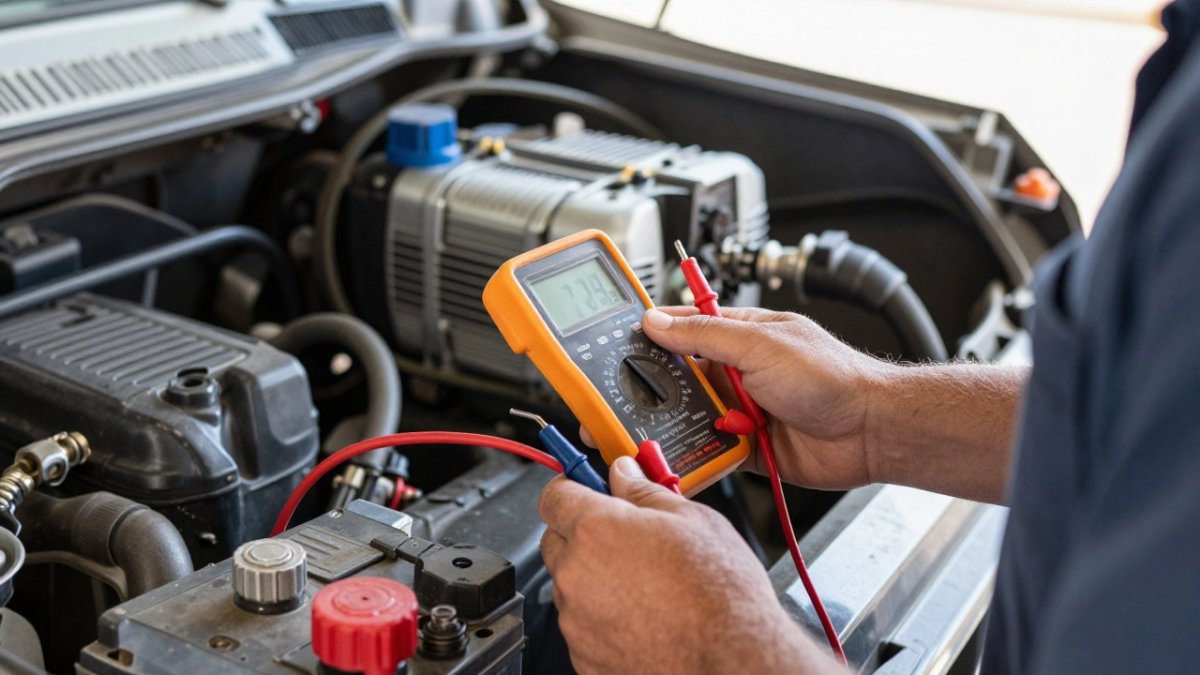
Follow these steps:
- Set the meter to DC volts. Choose the 20V range.
- Test with the engine off. Touch the red probe to the positive terminal and the black probe to the negative. A healthy, charged battery reads around 12.6 volts. A reading near 12.2 volts or lower suggests the battery is already discharged, which changes how you interpret the next steps.
- Start the engine and let it idle. Recheck the reading at the battery.
- Note the idle voltage. A healthy charging system typically reads around 13.5 to 14.5 volts at idle. If you see battery voltage, near 12.6 or lower, the alternator is not charging at idle.
- Load the system at idle. Turn on the headlights, high beams, HVAC blower on high, and any work lights or accessories the truck normally runs. Watch the voltage. A healthy alternator holds roughly 13.5 volts or better under that load; a weak one sags toward battery voltage or below.
- Rev the engine slightly. If voltage climbs with RPM and drops back at idle, the unit is weak.
- Check the connections. Inspect battery terminals, wiring, and the ground connection for corrosion or looseness before condemning the alternator.
Watch out: never disconnect a battery cable while the engine runs to "test" the alternator. On modern trucks this can damage the computer and voltage regulator.
Normal vs. Abnormal at Idle
Steady 13.5 to 14.5 volts at idle is normal. A reading that sits at battery voltage, swings wildly, or only rises with RPM is abnormal. But those numbers are a range, not a rule. Readings vary with battery state of charge, ambient temperature, alternator temperature, and the truck's charging strategy. Many modern trucks use computer-controlled charging that varies voltage at times, so a brief dip below 13.5 volts is not automatically a failure. What matters is the pattern: voltage that stays low at idle, falls further under load, and recovers only when RPM rises is the signature of a weak alternator.
Rule Out the Other Causes First
Low charging output at idle is not always a failed alternator. Before you replace the unit, check the cheaper and more common culprits:
- Belt condition and tension, a glazed, frayed, or slipping serpentine belt lets the alternator pulley slip at idle, when belt speed is lowest. Check the tensioner and the belt routing.
- Battery condition, a weak or aged battery can drag system voltage down and make a good alternator look bad. Load-test the battery or have it tested.
- Corroded or loose connections, battery terminals, ground straps, and the alternator's charge cable are common sources of voltage drop. A voltage-drop test across the ground circuit is quick and decisive.
- Wiring and fusing, a damaged charge cable or blown fusible link stops charging regardless of alternator condition.
- Pulley and decoupler, some alternators use an overrunning or decoupler pulley that can fail and stop the unit from charging at low RPM.
If your test confirms low output and the belt, battery, connections, and wiring check out, electrical repair services can diagnose and fix the fault.
A weak alternator rarely fails all at once. It fades at idle first, then leaves you with a dead battery and a truck that will not start. Catch the five signs early and you avoid a breakdown on the road.
Frequently Asked Questions
What are the signs of a failing truck alternator at idle?
Watch for five signals: headlights and dash lights that dim or flicker when RPM drops, a battery warning light that glows at idle and fades when you rev the engine, slow cranking or repeated dead batteries, rough idle with accessories like AC or lights misbehaving, and a burning smell or belt noise near the alternator. Any one of these is worth a charging-system test before you replace parts.
Can a bad alternator cause a rough idle in a truck?
Yes. When a truck alternator stops charging at idle, the electrical system runs off battery voltage alone, and voltage dips can disturb the engine control module and sensor signals. That shows up as a rough idle, RPM fluctuations, or stalling at stops. Rule out fuel and air problems too, since low charging output is not the only cause of rough running.
How can I tell whether my truck has a bad alternator or a bad battery?
Test voltage with a multimeter. With the engine off, a healthy battery reads about 12.6 volts. At idle, a working alternator should hold roughly 13.8 to 14.4 volts at the battery terminals. If voltage stays near 12.4 to 12.6 with the engine running, the alternator is not charging. If it reads low with the engine off and climbs normally once running, the battery is the likely culprit.
Can you jump-start a truck with a bad alternator?
You can often jump-start it, but the truck will only run until the battery drains, since the alternator is not recharging it. Treat a jump as a way to move the truck to a safe spot or a shop, not a fix. On a commercial semi, repeated jump starts also stress the battery and starting system, so have the charging system tested before the next dispatch.