how-to
Diesel Engine Diagnostics for Fleet Trucks: A How-To Guide
Table of Contents
- What Is Diesel Engine Diagnostics?
- Common Diesel Engine Issues in Fleet Operations
- How to Read Semi Truck Fault Codes
- Essential Diagnostic Tools and Hardware for Heavy-Duty Trucks
- Heavy Duty Truck Diagnostic Software and OEM Solutions
- Fleet Maintenance Diagnostic Best Practices
- In-House vs. Outsourced Diagnostics: Cost and Capability Analysis
- Reducing Downtime Through Proactive Diesel Engine Diagnostics
- Frequently Asked Questions
Last Updated: September 23, 2026
What Is Diesel Engine Diagnostics?
Diesel engine diagnostics is the process of identifying mechanical and electrical problems in heavy-duty diesel engines using specialized tools and software. It combines hardware scanners, OEM software, and technician expertise to pinpoint issues before they cause breakdowns.
For fleet managers, this means catching problems early. A small sensor issue detected today prevents a $5,000 roadside repair tomorrow. Fairfield Truck Repair uses specialized diesel diagnostics to keep your trucks running instead of sitting idle waiting for parts.
The diagnostic process reads fault codes, analyzes live data streams, and examines freeze frame data captured at the moment a problem occurred. This approach replaces the old method of replacing parts until something works. You get precision instead of guesswork.
Common Diesel Engine Issues in Fleet Operations
Fleet trucks face predictable wear patterns. Understanding these issues helps you spot problems before drivers call in stranded.
Aftertreatment system failures rank among the most common. Diesel engines use selective catalytic reduction (SCR) and diesel particulate filter (DPF) systems to meet emissions standards. When these systems malfunction, the truck goes into limp mode, reduced power, poor fuel economy, and potential shutdown. A faulty NOx sensor or clogged DPF regeneration system can trigger these failures. Early detection saves thousands in repairs.
Transmission diagnostics reveal another frequent problem area. Heavy-duty transmissions work harder than any other component. Shifting delays, harsh engagements, or complete loss of gears often point to transmission fluid temperature sensors or pressure switches. A diagnostic scan catches these electrical faults before the transmission itself fails.
ABS and brake system codes appear regularly in fleet diagnostics. Wheel speed sensors accumulate road salt and debris. A single faulty sensor triggers fault codes that disable ABS across the entire vehicle. This creates safety and DOT compliance issues that must be resolved immediately.
Fuel system problems develop over time. Injector deposits reduce fuel atomization. Fuel pressure sensors drift out of calibration. These issues cause rough idle, poor starting, and excessive emissions. Diesel engine diagnostics reveals the exact injector or sensor causing the problem.
How to Read Semi Truck Fault Codes
Fault codes are the language your truck uses to report problems. Learning to read them separates fleet managers who fix problems from those who guess.
Diagnostic trouble codes (DTCs) follow a standardized format. A code like P0190 breaks down as follows: the "P" means powertrain, "0" indicates a standard code, "1" identifies the system (fuel and air metering), "9" pinpoints the specific component (fuel pressure sensor), and "0" describes the malfunction (circuit malfunction).
The first step is retrieving the code. A diagnostic scanner connects to the truck's OBD-II port, located under the dash on most heavy-duty trucks. The scanner reads the ECM and displays active codes and pending codes. Active codes triggered the check engine light. Pending codes appeared once but haven't repeated yet.
Freeze frame data captures the exact conditions when the fault occurred. Engine RPM, vehicle speed, fuel pressure, and sensor readings all freeze at that moment. This context helps technicians understand whether the problem happened during acceleration, idle, or a specific operating condition.
Here's how to interpret what you see:
- P-codes (powertrain): Engine, transmission, and emissions system faults
- C-codes (chassis): ABS, brake, and suspension issues
- B-codes (body): Door locks, windows, seat controls
- U-codes (network): Communication failures between modules
The second digit matters too. A "0" means standard code. A "1" means manufacturer-specific code unique to that truck brand. This distinction tells you whether you need OEM software to fully diagnose the problem.
Essential Diagnostic Tools and Hardware for Heavy-Duty Trucks
The right tools determine whether you diagnose accurately or waste time chasing phantom problems.
Diagnostic scanners form the foundation. Consumer-grade scanners read basic codes but stop there. Heavy-duty trucks require professional-grade scanners that access multiple modules, engine, transmission, ABS, body control modules. These devices cost more but deliver the depth needed for complex fleet diagnostics.
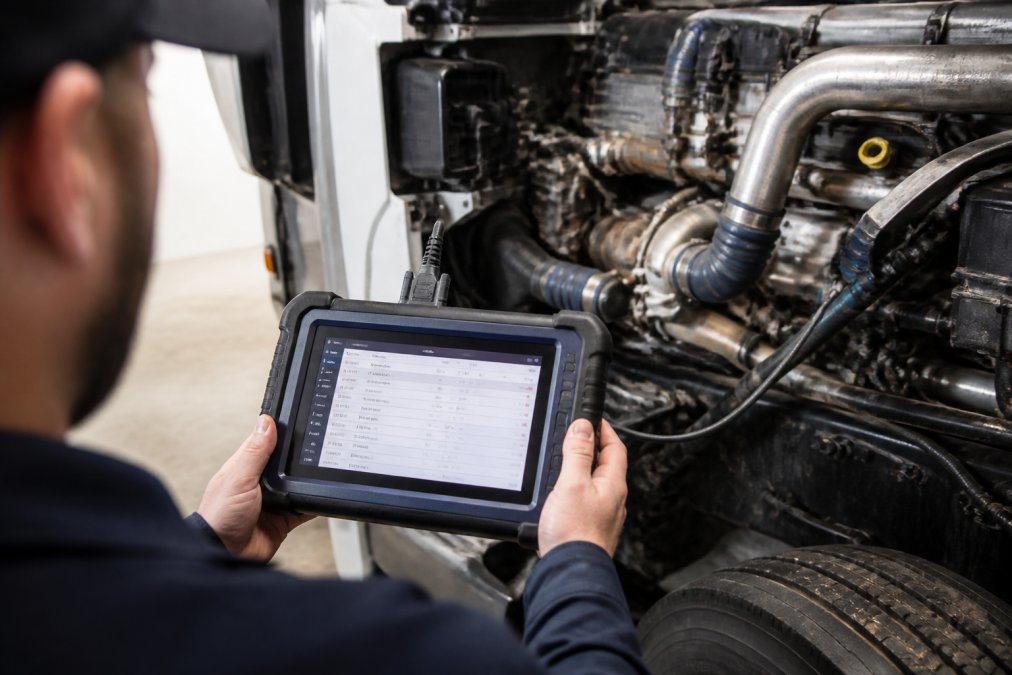
Ruggedized hardware matters for field work. Tablets and laptops get damaged in truck cabs. Purpose-built diagnostic devices withstand vibration, temperature swings, and accidental drops. They connect via wireless or hardwired CAN bus adapters.
Adapter cables enable communication between the scanner and the truck. OBD-II adapters work for older trucks. Newer heavy-duty vehicles use proprietary connectors. Having the correct adapter prevents connection failures that waste hours troubleshooting.
Live data streaming capability separates basic from advanced diagnostics. You need to watch sensor readings in real time, fuel pressure climbing during acceleration, coolant temperature stabilizing after startup, oxygen sensor voltage responding to throttle changes. This live data stream reveals whether a sensor drifts or responds correctly.
Essential tools for fleet diagnostics include:
- Professional diagnostic scanner with wireless capability
- Complete adapter cable set for your truck models
- Multimeter for electrical testing
- Fuel pressure gauge for system verification
- Infrared thermometer for temperature diagnosis
- Oscilloscope for advanced sensor analysis
Many fleet managers outsource diagnostics rather than buy this equipment.
Heavy Duty Truck Diagnostic Software and OEM Solutions
Hardware alone doesn't diagnose trucks. Software interprets the data and connects codes to real-world problems.
Live data streaming through software lets technicians monitor:
- Engine load and fuel trim adjustments
- Transmission fluid temperature and pressure
- Aftertreatment system regeneration cycles
- Sensor voltage and resistance values
- Fault code history and pending codes
Fleet Maintenance Diagnostic Best Practices
Proactive diagnostics prevents emergency repairs that disrupt operations.
Scheduled diagnostic scans catch problems before they become codes. Monthly scans on high-mileage trucks identify sensor drift, electrical degradation, and component wear. Pending codes appear before they trigger check engine lights.
Train your technicians on proper diagnostic procedure:
- Connect the scanner and retrieve all codes (active and pending)
- Document freeze frame data from the moment the fault occurred
- Clear codes and perform a road test to see if codes return
- Access live data streams to verify sensor response
- Cross-reference codes with service bulletins for your truck model
- Perform electrical testing if sensor readings seem incorrect
- Replace only the component confirmed as faulty
In-House vs. Outsourced Diagnostics: Cost and Capability Analysis
The decision between in-house and outsourced diagnostics depends on fleet size, truck diversity, and breakdown frequency.
Cost comparison factors:
- Fleet size: Larger fleets justify equipment investment
- Truck models: Mixed brands favor outsourced specialists
- Breakdown frequency: High frequency favors in-house
- Technician availability: Limited staff favors outsourced
- Downtime tolerance: Time-sensitive operations need in-house speed
Reducing Downtime Through Proactive Diesel Engine Diagnostics
Preventative diagnostics integrates with your maintenance schedule. Oil changes include diagnostic scans. Tire rotations include electrical system checks. Major services include comprehensive diagnostics. Problems get caught and fixed during planned downtime when you expect trucks to be unavailable.
Frequently Asked Questions
How do you interpret fault codes on a commercial diesel engine?
Fault codes on commercial diesel engines are five-digit diagnostic trouble codes (DTCs) that identify specific system failures. The first digit indicates the system (P for powertrain, C for chassis, B for body, U for network), followed by digits specifying the fault type and location. Use your diagnostic scanner to pull the code, then cross-reference it with your engine manufacturer's documentation or software database. Freeze frame data captured at the moment of failure helps distinguish between active and intermittent problems. Always address the root cause, not just the code, to prevent recurrence.
What diagnostic tools do fleet managers need for heavy-duty trucks?
Fleet managers need a ruggedized diagnostic scanner capable of reading multiple engine manufacturers' codes, adapter cables for CAN bus connectivity, and software that supports OEM protocols for your specific truck models. Many operations also benefit from telematics systems that monitor vehicle health in real time and alert technicians to emerging issues before they cause breakdowns. Depending on your fleet size, investing in in-house diagnostic capability versus outsourcing to a specialist shop depends on your annual repair volume and technician training capacity.
How does proactive diesel engine diagnostics reduce fleet downtime?
Proactive diagnostics catch sensor calibration issues, aftertreatment system problems, and transmission faults before they cause complete failures. Regular live data stream monitoring reveals patterns in engine performance that signal wear or degradation. By identifying and addressing these issues during scheduled maintenance rather than waiting for roadside breakdowns, fleets reduce emergency repair costs and keep vehicles on the road. Preventative maintenance programs backed by diagnostic data typically reduce unplanned downtime by 20-30% compared to reactive repair models.
What is the difference between OBD and OEM diagnostic software?
OBD (on-board diagnostics) is a standardized system that reads basic fault codes from any vehicle's ECM, but it provides limited detail. OEM (original equipment manufacturer) software offers manufacturer-specific protocols, deeper access to live data streams, freeze frame information, and the ability to perform advanced troubleshooting on transmission, ABS, and emissions systems. For fleet operations running multiple engine brands, OEM software is essential for accurate diagnostics and reducing guesswork during repairs.