listicle
Choosing a Reliable Fleet Maintenance Partner
Table of Contents
- What Makes a Reliable Fleet Maintenance Partner
- Heavy-Duty Truck Repair Shop Evaluation Checklist
- Fleet Maintenance Outsourcing Benefits
- Calculating Fleet Maintenance ROI
- Critical Questions to Ask Before Committing
- Red Flags That Signal an Unreliable Partner
- Managing the Relationship After Contract Signing
- Frequently Asked Questions
Last Updated: September 28, 2026
What Makes a Reliable Fleet Maintenance Partner
A reliable fleet maintenance partner prevents breakdowns before they happen, minimizing downtime and repair costs while giving you visibility into your fleet's health.
Choosing a reliable fleet maintenance partner affects every mile your trucks run, the right choice means predictable operations, stable budgets, and reliable support when you need it.
This guide breaks down exactly how to evaluate a potential partner so you don't discover critical gaps after you've signed a contract.
Heavy-Duty Truck Repair Shop Evaluation Checklist
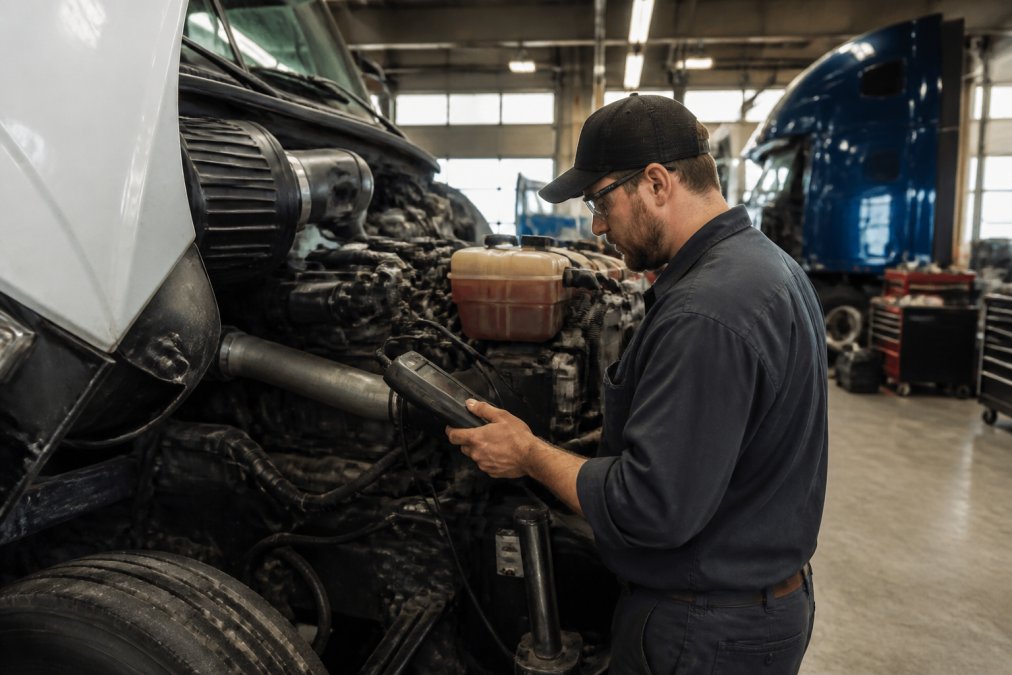
Evaluating a repair shop requires verifying technical expertise, understanding their service model, and confirming they can deliver on promises.
Technical Expertise and Certification
Ask whether technicians hold ASE (Automotive Service Excellence) certifications specific to heavy-duty diesel engines (ASE Certification Test Series).
Ask about manufacturer training for your specific engine line (Cummins, Duramax, Powerstroke). Diesel diagnostics require specialized knowledge, a trained technician can read fault codes and prevent recurring failures across your fleet.
Ask about their diagnostic equipment and capabilities for your fleet's make and model. Modern diesel diagnostics require specialized scanners; basic OBD-II readers are insufficient.
Service Level Agreements and Response Times
A service level agreement (SLA) puts accountability in writing, specifying response times and repair turnaround times. Without one, commitments are meaningless.
Ask: What's your response time for breakdowns? Average turnaround for common repairs? Availability for 2 AM emergencies? Do you charge premiums for emergency calls? Both response time and repair duration matter equally.
Compliance and Safety Standards
Your partner must understand DOT and FMCSA regulations. Ask if they perform DOT inspections, maintain audit-ready records, and understand out-of-service criteria. Unfamiliarity puts your company at legal risk.
Fleet Maintenance Outsourcing Benefits
Outsourcing transfers expertise and equipment costs away from your operation, eliminating the need to maintain an in-house shop and manage technician schedules.
Minimizing Vehicle Downtime
Every hour a truck sits in the shop is lost revenue. Ask how the partner prioritizes work, schedules preventative maintenance, and maintains parts inventory.
Proactive vs. Reactive Maintenance
Proactive maintenance spreads costs across the year and prevents emergencies; reactive maintenance means crisis mode and premium rates. A reliable fleet maintenance partner tailors schedules to your trucks' actual duty cycles. Replacing a water pump during scheduled maintenance costs far less than replacing it plus an engine rebuild after failure.
Calculating Fleet Maintenance ROI
Calculate ROI by comparing current maintenance costs against the partner's fees, accounting for reduced downtime, fewer emergencies, and transition costs.
Step 1: Establish Your Current Baseline
Track your current annual costs: parts, labor, equipment, and facility overhead.
Downtime and Emergency Costs:
- Average hours of downtime per month (track this in your dispatch system)
- Cost of downtime per hour (lost revenue per truck × number of trucks idle simultaneously). For example: if a truck generates $150/hour in revenue and you have 2 trucks down simultaneously for 4 hours, that's $1,200 in lost revenue.
- Annual downtime cost: (monthly downtime hours × 12) × cost per hour
- Emergency repair premiums: Track how much extra you pay for urgent repairs (weekend calls, after-hours diagnostics, expedited parts). Many fleets pay 25-50% premiums on emergency work.
- Total emergency premium annually.
Hidden Costs of In-House Maintenance:
- Technician turnover and training: Diesel technicians are scarce. Calculate the cost of recruiting, hiring, and training a replacement technician (typically $8,000-$15,000 per hire).
- Idle technician time: If your fleet is small or maintenance is seasonal, technicians may be underutilized. Calculate the cost of paying technicians during slow periods.
- Compliance and audit costs: If you're managing DOT records and FMCSA compliance in-house, estimate the time spent (often 5-10 hours per month for a fleet of 20+ trucks).
Your Current Total Cost = Direct Maintenance + Downtime Cost + Emergency Premiums + Hidden Costs
Step 2: Model the Partner's Proposal
Request a detailed proposal from the maintenance partner that includes:
Service Costs:
- Monthly or annual maintenance contract fee (often a per-truck-per-month rate)
- Hourly labor rates for work outside the contract (diagnostics, emergency repairs)
- Parts markup
- Emergency call surcharges (if any)
Transition Costs (one-time):
- Data migration: Moving your maintenance history and compliance records
- Integration setup: Connecting their system to your fleet management software
- Training: Teaching your dispatch team how to schedule maintenance and access reports
Projected Savings (from the partner's proposal):
- Reduced downtime (hours saved annually × cost per hour)
- Eliminated emergency premiums (if the partner's proactive maintenance prevents breakdowns)
- Parts volume discounts (partners buy parts in bulk and pass savings to you)
- Eliminated in-house technician costs (if you can reduce or eliminate your internal shop)
Partner's Total Cost = Monthly Contract Fee + Labor Overages + Parts Markup + Transition Costs (amortized over contract term)
Step 3: Calculate Net ROI
Year 1 ROI:
Net Benefit = (Current Total Cost) − (Partner's Total Cost)
ROI % = (Net Benefit / Partner's Total Cost) × 100
Example for a 20-truck fleet:
Current baseline (in-house):
- Direct maintenance: $180,000/year
- Downtime cost (100 hours/month × 12 × $150/hour): $216,000/year
- Emergency premiums: $24,000/year
- Technician turnover and training: $10,000/year
- Total: $430,000/year
Partner proposal:
- Contract fee (20 trucks × $500/truck/month × 12): $120,000/year
- Labor overages (estimated 10% of work outside contract): $12,000/year
- Parts markup (estimated 20% above current): $36,000/year
- Transition costs (one-time): $3,000
- Total Year 1: $171,000
Year 1 ROI:
- Net Benefit: $430,000 − $171,000 = $259,000
- ROI: ($259,000 / $171,000) × 100 = 151% return
Year 2+ ROI (no transition costs):
- Partner's cost: $120,000 + $12,000 + $36,000 = $168,000/year
- Net Benefit: $430,000 − $168,000 = $262,000
- ROI: ($262,000 / $168,000) × 100 = 156% return
Step 4: Account for Variables and Risks
The calculation above assumes the partner delivers on their commitments. Reality is messier. Build in contingencies:
Downtime Reduction Risk: Partners often project 20-30% reductions in downtime through proactive maintenance. This is realistic if you're currently reactive, but verify with references. Ask the partner for case studies showing actual downtime reduction in fleets similar to yours. Consistent application of these rigorous verification methods serves as the foundation for reducing fleet downtime across your entire operational cycle.
Parts Markup Variance: If the partner sources parts from different suppliers than you currently use, costs may vary. Ask for a parts pricing guarantee or a cap on markup.
Transition Period: Expect 2-3 months of adjustment where downtime may temporarily increase as the partner learns your fleet's quirks. Factor this into Year 1 projections.
Contract Lock-in: Most maintenance partnerships require 2-3 year contracts. If the partner underperforms, you're locked in. Build an exit clause into the contract (see "Managing the Relationship After Contract Signing").
Step 5: Sensitivity Analysis
Test your ROI under different scenarios:
Conservative scenario: Assume only 10% downtime reduction (instead of 20%), and the partner's labor rates are 10% higher than quoted.
Optimistic scenario: Assume 30% downtime reduction and the partner achieves the full parts discount.
Break-even analysis: At what downtime reduction does the partnership break even? If the answer is "more than 40%," the financial case is weak.
Most fleets see positive ROI within 6-12 months when switching from reactive to proactive maintenance, assuming the partner is competent. The savings come from fewer emergency calls, reduced parts costs through volume purchasing, and predictable budgeting. However, ROI depends entirely on the partner's ability to reduce downtime and prevent emergencies.
Critical Questions to Ask Before Committing
Before signing a contract, ask these questions in writing. Require written answers. Verbal promises disappear when disputes arise.
On Technical Capability:
- What's your experience with my specific truck makes and models?
- Do you have technicians with manufacturer-specific training?
- What diagnostic equipment do you use, and how current is it?
On Responsiveness:
- What's your average response time for emergency calls?
- How many trucks can you service simultaneously?
- What happens if you're fully booked when I have a breakdown?
On Costs:
- How is labor billed (hourly, flat rate, or per-job)?
- Are emergency calls billed at a premium?
- What happens if diagnostics reveal an issue you can't fix?
On Accountability:
- Will you provide a written SLA?
- How do you handle warranty on parts and labor?
- What's your process if a repair doesn't solve the problem?
On Integration:
- Can you integrate with my fleet management software?
- How do you report maintenance history and costs?
- Can I access real-time status on my trucks?
Red Flags That Signal an Unreliable Partner
Vague on Details: If they can't explain their diagnostic process or give specific response times, they're not serious about accountability. "We'll get there as soon as we can" isn't a commitment.
Managing the Relationship After Contract Signing
The partnership doesn't end at contract signature. Active management ensures you get the service you paid for.
Frequently Asked Questions
What are the main benefits of outsourcing fleet maintenance?
Outsourcing fleet maintenance reduces administrative overhead, gives you access to specialized technician expertise, and enables predictive maintenance scheduling that catches issues before they cause breakdowns. A reliable fleet maintenance partner manages maintenance logs, coordinates parts procurement, and handles vendor vetting, freeing your team to focus on core operations. Most importantly, outsourcing lowers total cost of ownership by preventing expensive emergency repairs through scheduled maintenance and real-time vehicle diagnostics.
How do I evaluate a heavy-duty truck repair shop?
Check for DOT compliance capabilities and a documented track record with heavy-duty diesel engines. Ask about their service level agreements, emergency roadside assistance availability, and average repair turnaround times. Request references from other fleet operators and review their maintenance history documentation practices.
How does preventive maintenance reduce fleet downtime?
Preventive maintenance follows a scheduled maintenance program based on duty cycles and manufacturer recommendations, addressing wear before critical failures occur. This contrasts with reactive maintenance, which only repairs problems after they happen. Scheduled maintenance reduces unexpected breakdowns that halt operations, while predictive maintenance using vehicle diagnostics identifies developing issues during routine service. The result is higher asset utilization and fewer emergency repairs that disrupt routes and increase costs.
What should I include in a service level agreement with a maintenance partner?
A strong SLA defines response times for emergency roadside assistance (especially critical for 24/7 operations on highways), maximum repair turnaround times, technician certification requirements, and guaranteed parts availability. Specify how maintenance schedules will be managed, what compliance documentation you'll receive, and the process for contract termination if service standards aren't met. Clear SLAs protect both parties and ensure operational efficiency expectations are aligned.