 blog
Alternatives to Dealership Truck Repair for Fleet Maintenance
Last Updated: November 14, 2026
Quick Summary
Alternatives to dealership truck repair for fleet maintenance include in-house shops, independent repair shops and third-party maintenance networks, mobile truck repair, maintenance contracts, and pay-as-you-go repairs. A hybrid model matches each job to the cheapest capable option, reserving the dealership for warranty and brand-specific work. This cuts out-of-service time without sacrificing repair quality.
- Dealership service bays can be booked out for weeks, and each waiting day is lost revenue.
- In-house shops suit large, uniform fleets but bring overhead and technician hiring challenges.
- Mobile service handles diagnostics, brakes, tires, electrical faults, and filters, but not major overhauls.
- An SLA should include both response-time and repair-time targets, not response times alone.
- Pilot one lane or site and track downtime, cost per unit, and rework before expanding.
Table of Contents
- Why Fleets Are Moving Away From Dealership Truck Repair
- In-House Fleet Maintenance vs. Outsourcing: Which Model Fits Your Operation
- Independent Repair Shops and Third-Party Maintenance Networks
- Mobile Truck Repair for Fleets: What It Handles and What It Doesn't
- Fleet Maintenance Contracts vs. Pay-as-You-Go Repairs
- How Fleet Maintenance Software Ties Your Program Together
- Building a Hybrid Maintenance Model for Your Fleet
- Choosing a Repair Partner for Your Fleet
- Frequently Asked Questions
Why Fleets Are Moving Away From Dealership Truck Repair
Dealership truck repair is the practice of sending commercial vehicles to an original equipment manufacturer's service center for maintenance and fixes. Many fleets are reconsidering that default. Many fleet managers report the same frustration: dealership service bays can be booked out for weeks, and every day a truck sits waiting is a day it isn't earning.
The Real Cost of Dealership Dependency
The sticker price of a repair is only part of the bill. Dealership dependency adds hidden costs that rarely show up on an invoice:
- Out-of-service time. A truck waiting for a service appointment isn't hauling freight, and that lost revenue often dwarfs the repair itself.
- Rigid scheduling. Dealerships run on their own timetable, not yours. A breakdown at the wrong moment can mean days of delay.
- Brand-specific lock-in. Some dealerships prioritize warranty work and brand-specific service, which can push routine jobs to the back of the line.
When you weigh other heavy-duty repair options, the real comparison isn't just labor rates. It's cost per mile once downtime is factored in.
In-House Fleet Maintenance vs. Outsourcing: Which Model Fits Your Operation
In-house fleet maintenance means staffing your own technicians and shop; outsourcing hands scheduled service and repairs to an outside provider. Neither model wins outright. The right choice depends on fleet size, vehicle mix, and how much control you need.
When In-House Makes Sense
A dedicated shop pays off when you run enough trucks to keep technicians busy full-time and your vehicles share similar platforms. You gain scheduling control and direct oversight. The trade-offs are real: tooling, parts inventory, and finding qualified diesel technicians who stay.
When Outsourcing Wins
Smaller fleets and operations with mixed equipment usually get more from an outsourced maintenance provider. You avoid the overhead of a shop and gain access to broader diagnostic expertise. The catch is choosing a partner with the capacity to match your service intervals.
Independent Repair Shops and Third-Party Maintenance Networks
Independent repair shops and third-party maintenance networks give fleets an alternative to dealership service without building a shop. Independents often handle heavy-duty trucks, diesel diagnostics, and brand-specific service across multiple makes.
What most guides miss is that independence doesn't mean less capability. A well-equipped independent shop can match dealership diagnostics on most commercial vehicles. Ask about technician certifications, parts availability, and repair turnaround time before you commit.
Mobile Truck Repair for Fleets: What It Handles and What It Doesn't
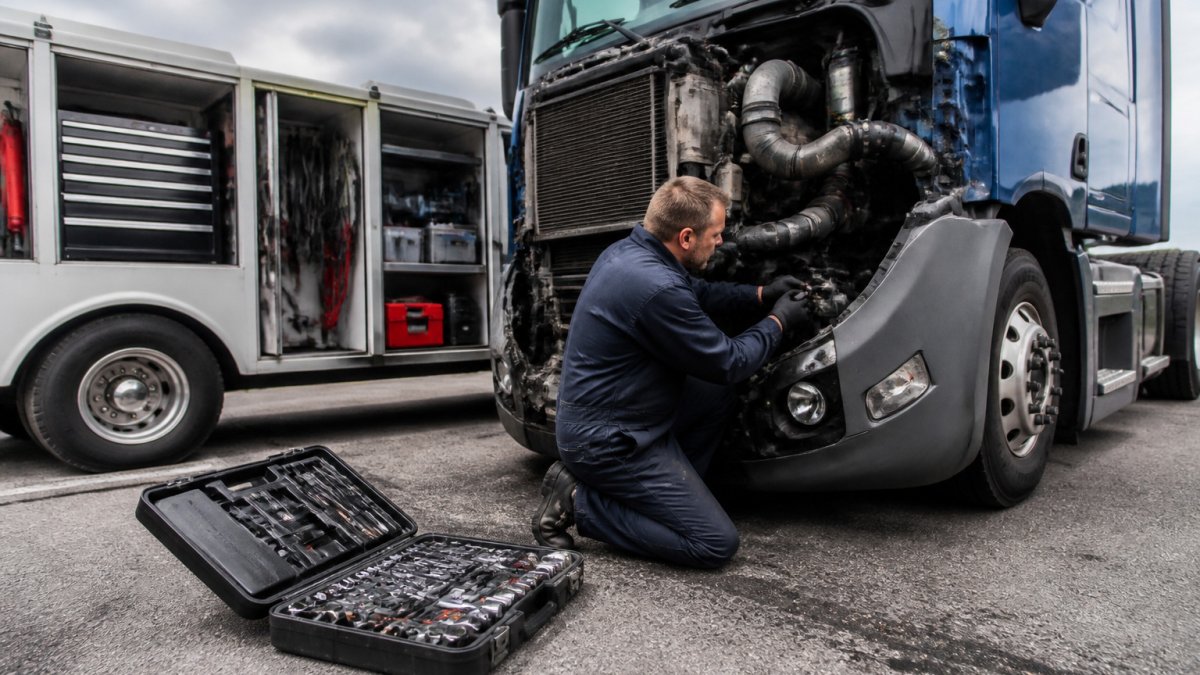
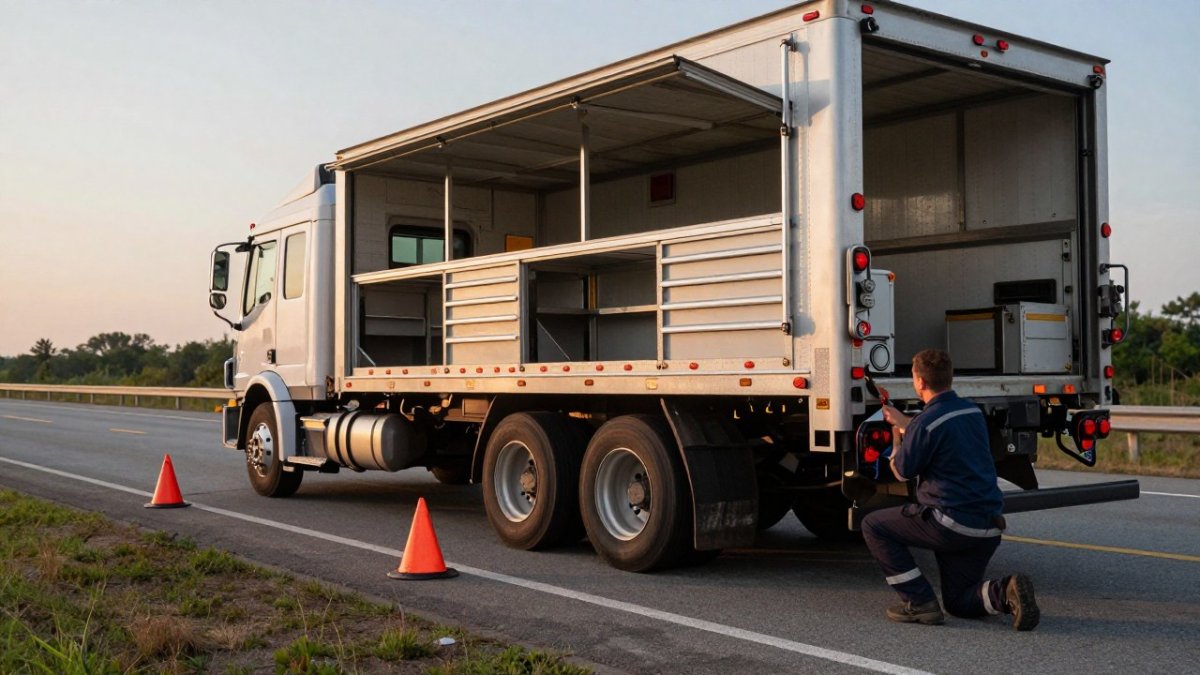
Mobile truck repair for fleets brings a technician and a service truck to your yard, a customer site, or the roadside.
Jobs That Commonly Fit Mobile Service
Most mobile providers are equipped to handle work that can be completed with hand tools, diagnostic software, and the parts carried on the service truck. Common examples include:
- Diagnostics and fault codes. Reading engine, aftertreatment, and electrical faults and clearing codes after a repair.
- Brake and air system work. Slack adjusters, chambers, valves, lines, and many air leaks.
- Tire and wheel issues. Roadside tire changes, inflation problems, and wheel-end inspections.
- Electrical faults. Lighting, sensors, battery and charging issues, and many wiring repairs.
Jobs That Usually Require a Shop
Mobile service does not replace a fully equipped shop. Jobs that typically need a lift, heavy tooling, a controlled environment, or manufacturer-specific procedures include:
- Major engine overhauls and in-frame rebuilds.
- Transmission swaps and clutch replacement.
- Differential and rear-end rebuilds.
- Frame, suspension, and structural repairs that require alignment equipment.
A common pattern is for a mobile technician to diagnose the fault on-site, complete the roadside-safe portion, and then send the truck to a shop for the remainder. Staging repairs this way can keep the truck moving sooner.
Safety and Site Boundaries
Mobile work happens in uncontrolled environments, so suitability is not only mechanical. Some providers will decline certain jobs on a live highway shoulder, in extreme weather, or on a slope. Ask your provider how they handle:
- Traffic control. Whether they set out cones and triangles and whether they require a spotter or lane closure.
- Site access. Whether your yard has room for a service truck and whether the technician can work safely near moving equipment.
- Environmental rules. How fluids, filters, and batteries are contained and removed from the site.
- Lockout and permit requirements. Whether your facility requires permits, escorts, or lockout/tagout procedures.
Watch out: a provider that quotes a low mobile rate but then bills travel time, after-hours premiums, and a second trip for parts can erase the savings. Confirm what the rate covers before dispatch.
Dispatch, Response, and After-Hours Expectations
Mobile service is only as good as its dispatch. Before you rely on a provider, confirm:
- Response-time commitments. Whether the provider quotes an arrival window and what happens when it is missed.
- After-hours coverage. Whether nights, weekends, and holidays are staffed or routed to an answering service.
- Geographic reach. How far the provider travels and whether travel time is billed.
- Parts availability. Which parts are carried on the truck and which require a parts run.
- Communication. Whether you get status updates, a written diagnosis, and a repair record you can import into your maintenance system.
If you are deciding between mobile service and a shop visit, this breakdown of mobile truck repair versus shop service lays out the trade-offs. For a breakdown at night, confirm your provider's after-hours dispatch and response window before you need it, not after.
Fleet Maintenance Contracts vs. Pay-as-You-Go Repairs
A fleet maintenance contract bundles scheduled service and preventive maintenance into a recurring program; pay-as-you-go means you pay per repair as issues arise. Contracts trade flexibility for predictability. Pay-as-you-go trades predictability for lower upfront commitment.
Contracts tend to win when preventive-maintenance compliance is slipping and breakdowns are eating your budget. Before you choose, get clear cost benchmarks, which this heavy-duty maintenance pricing guide covers in detail.
| Model | Best For | Watch Out For |
|---|---|---|
| Dealership service | Warranty and brand-specific work | Long waits, limited scheduling control |
| In-house shop | Large, uniform fleets | Overhead and technician hiring |
| Independent shop | Mixed makes, routine repairs | Verify capacity and parts access |
| Mobile repair | Roadside and on-site fixes | Not for major overhauls |
| Maintenance contract | Predictable budgets | Less flexibility on scope |
| Pay-as-you-go | Newer, low-mileage fleets | Unpredictable repair costs |
How Fleet Maintenance Software Ties Your Program Together
Fleet maintenance software tracks work orders, maintenance records, and service intervals in one place. It's the difference between reacting to breakdowns and preventing them. Good software flags upcoming service, logs repair history per vehicle, and shows cost per mile so you can see which trucks are draining your budget.
The software doesn't fix trucks, but it makes the repair tracking and service coordination behind any maintenance model far easier to manage.
Building a Hybrid Maintenance Model for Your Fleet
A hybrid model mixes in-house work, an independent shop, and mobile service depending on the job. Routine inspections and minor service can stay in-house or go to a mobile provider; complex diagnostics and major repairs go to a shop with the right equipment.
The logic is simple: match the repair to the cheapest capable option. Use mobile service for on-site fixes, an independent shop for scheduled maintenance, and reserve the dealership for warranty and brand-specific work. This approach cuts out-of-service time without sacrificing repair quality.
Choosing a Repair Partner for Your Fleet
Choosing a repair partner comes down to capacity, coverage, and communication, but the difference between a good fit and a costly one is in the details of the agreement. Most guides stop at a list of questions. The more useful approach is to evaluate providers against written criteria and to plan the transition before you sign.
Evaluate Against Written Criteria
Build a short scorecard and rate each candidate on the same dimensions:
- Capacity. How many bays, technicians, and mobile units they can commit to your fleet, and how they prioritize you during peak season.
- Coverage. The geographic radius they serve, whether they offer roadside and after-hours service, and how travel time is billed.
- Response-time commitments. Whether arrival and repair windows are written into the agreement and what credits or escalation apply when they are missed.
- Diagnostic capability. Technician certifications, diagnostic software, and experience with your vehicle makes and aftertreatment systems.
- Parts availability. Which parts are stocked, typical lead times, and whether they use OEM, aftermarket, or remanufactured parts by default.
Put It in a Service-Level Agreement
A service-level agreement turns verbal promises into measurable commitments. At minimum, ask for:
- Response and repair-time targets by job type and time of day.
- After-hours and holiday coverage terms.
- Parts sourcing and approval rules, including a cap on parts markup.
- Warranty duration and what voids it.
- Reporting cadence and data format.
Watch out: an SLA that lists response times but not repair-time targets can still leave a truck in the bay for days. Ask for both, and ask what happens when a target is missed.
Plan the Transition
Moving away from dealership-dependent service is a project, not a switch. A practical sequence is:
- Inventory your current service mix. List which repairs go to the dealership, which are warranty, and which are routine.
- Pilot one lane or one site. Route a subset of vehicles to the new provider for a defined period and track downtime, cost per unit, and rework.
- Transfer records. Get maintenance history, warranty documents, and open work orders into your system so the new provider has context.
- Onboard the provider. Share your service intervals, vehicle list, site access rules, and escalation contacts.
- Review after the pilot. Compare against your baseline and adjust scope before expanding.
Fairfield Truck Repair offers fleet maintenance service, including comprehensive fleet maintenance, specialized diesel diagnostics, and roadside service to help keep vehicle downtime low. For a deeper evaluation framework, our guide on how to choose a fleet maintenance provider walks through the criteria that matter.
Downtime is the silent budget killer in fleet operations, and the fix starts with the right maintenance partner. Fairfield Truck Repair offers expert heavy-duty truck repair, specialized diesel diagnostics, comprehensive fleet maintenance, and roadside service designed to minimize vehicle downtime.
Frequently Asked Questions
Is it cheaper to use an independent truck repair shop or a dealership?
Independent shops and dealership service centers can differ in labor rates and parts sourcing options. Dealerships may be required for warranty-covered work on newer trucks. Get written estimates from both and compare total cost, including downtime, before deciding.
Can mobile truck repair handle routine fleet maintenance?
Mobile truck repair for fleets can be suited to some scheduled service and minor repairs, especially when trucks are parked at a yard overnight. It is less suited to major engine overhauls, transmission work, or structural repairs that need a full shop with lifts and specialized tooling. A practical approach is to route routine service to mobile units and send heavy repairs to a fixed shop.
What should fleet managers look for in a truck repair provider?
Look for certified diesel technicians, clear diagnostic processes, documented work orders, and realistic turnaround commitments. Ask about parts availability, roadside response times, and whether the provider offers fleet maintenance contracts with defined service intervals. Check that they can produce maintenance records for DOT compliance. A provider that explains how it diagnoses problems, rather than just quoting parts, is usually the safer long-term partner.
When should a fleet bring maintenance in-house?
In-house fleet maintenance usually makes sense once you have enough trucks to keep a full-time technician busy, depending on vehicle age and duty cycle. You also need shop space, tooling, and a parts inventory. Below that threshold, the fixed cost of staff and equipment often exceeds what you would pay an outsourced provider. Many smaller fleets run a hybrid model instead, handling inspections in-house and outsourcing repairs.