ultimate-guide
Emergency Roadside Assistance for Semi Trucks: 2026 Guide
Table of Contents
- What Emergency Roadside Assistance for Semi Trucks Actually Covers
- Heavy-Duty Mobile Truck Repair: What Gets Fixed On the Shoulder
- What a Semi Truck Breakdown Cost Really Looks Like
- Mobile Truck Diagnostics: Why the First 30 Minutes Decide Everything
- Driver Safety Protocols During a Breakdown on the Highway
- Fleet Coverage, Documentation, and Insurance Reimbursement
- Frequently Asked Questions
Last Updated: September 16, 2026
What Emergency Roadside Assistance for Semi Trucks Actually Covers
Emergency roadside assistance for semi trucks is a dispatch-based service that sends a mobile mechanic or tow unit to a commercial vehicle stranded on the highway, at a dock, or in a yard, and either repairs it on the spot or moves it to a shop.
Mobile Mechanic vs. Towing: Which One You Actually Need
A mobile mechanic comes to the truck with tools, diagnostic equipment, and common parts; towing moves it to a fixed shop. Choose the mobile mechanic when the repair is accessible from outside the vehicle and the diagnosis is clear. Choose towing for internal engine or transmission damage, when the truck blocks a live lane, or when the repair needs a lift.
Heavy-Duty Mobile Truck Repair: What Gets Fixed On the Shoulder
Heavy-duty mobile truck repair covers the work a qualified technician can complete at the vehicle's location without a shop bay. Its limits are set by three things: whether the failed component is reachable from outside the vehicle, whether the service truck carries the right part, and whether the repair can be done safely with traffic passing a few feet away.
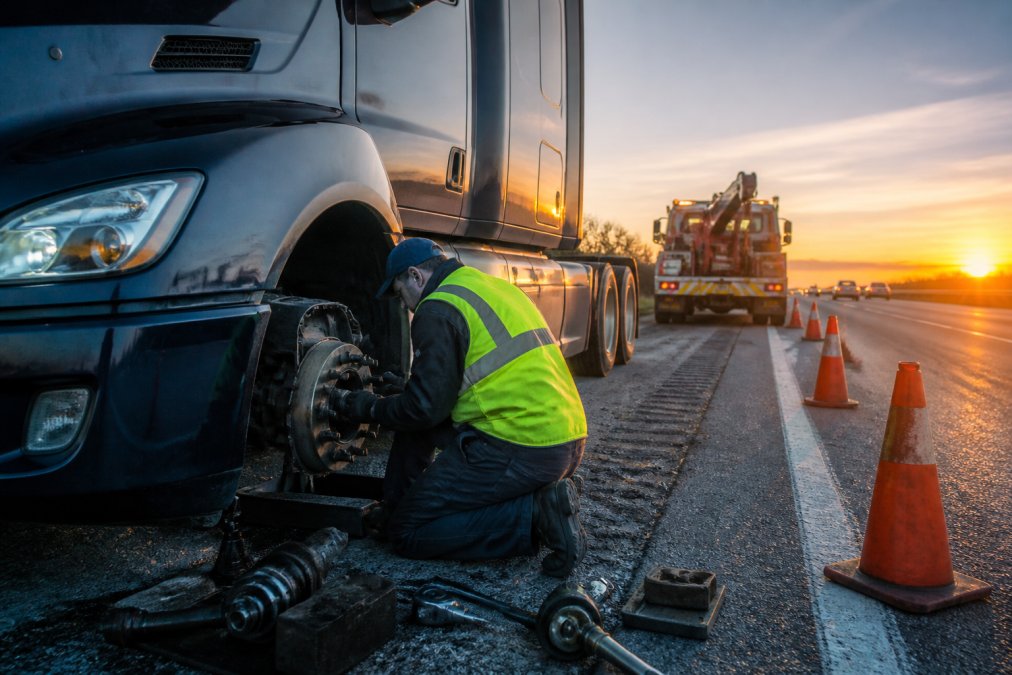
Tire Service, Fuel Delivery, Jump Starts, and Lockouts
These four calls make up the bulk of on-demand dispatch volume.
- Tire service. Blowouts, valve stem failures, and wheel-end problems are the most common roadside call. The technician mounts the truck's spare or brings a replacement tire sized to the axle. A steer tire blowout is treated differently from a drive or trailer tire because of the handling risk, and many providers will not patch a sidewall or a tire with cord damage. Expect a wheel-end heat check before mounting, since a failed bearing often causes the blowout.
- Fuel delivery. Running dry happens more often than fleets admit when routing and fuel planning fall out of sync. The technician brings diesel, but the real work is priming the system afterward: on many modern engines, running a common-rail system dry means cycling the lift pump and bleeding air from the lines before the engine restarts. A fuel call is rarely a five-minute stop.
- Jump starts. A dead battery on a commercial vehicle usually signals an alternator or charging system fault rather than a one-time drain. A jump gets the truck running, but the technician should test the charging system before the driver rolls, or it will die again within a few miles.
- Lockouts. Lockout service gets a driver back in the cab without damaging door or window seals. On newer trucks with electronic latches and air-actuated doors, the technician needs the right tools to avoid breaking trim or triggering a fault.
Driveline, Air System, and Cooling System Repairs
- Driveline. Roadside driveline work typically means U-joints, driveshaft components, and differential issues reachable without dropping the whole assembly. A failed U-joint can sometimes be replaced on the shoulder if the yoke is undamaged and the right joint is on the truck. A broken driveshaft or differential failure almost always means a tow, because the repair needs a press, a clean work area, and parts not carried on a service truck.
- Air system. This is a safety-critical call. A truck that cannot build or hold air pressure cannot safely brake, and the parking brakes may not release. The technician finds the leak at the source, a hose, fitting, valve, or compressor line, and either repairs it or arranges recovery. A truck with an air system fault should never be driven on the highway, even a short distance.
- Cooling system. Cooling system repair covers hoses, clamps, belts, and water pumps that fail in service. A burst hose or thrown belt is a classic roadside fix. A failed water pump is a judgment call: some can be replaced on the shoulder, but the job is tight and the right pump must be on the truck. Overheating damage to a head gasket is not a roadside repair.
- Electrical and diagnostics. On modern trucks, a large share of "mechanical" breakdowns trace back to a wiring or sensor fault. A derate, a no-start, or a sudden loss of power is often a sensor, connector, or chafed harness. A technician with real diagnostic tools saves the most downtime here, because the alternative is an unnecessary tow.
What Does Not Get Fixed On the Shoulder
Just as important as what a mobile technician can do is what they cannot. Internal engine damage, transmission and clutch failures, aftertreatment and DPF problems requiring a forced regen or bake-out, structural frame damage, and anything needing a lift or press are shop jobs. A good dispatcher says so up front rather than sending a technician who cannot finish the job.
What a Semi Truck Breakdown Cost Really Looks Like
Semi truck breakdown cost has two layers: the direct service charge and the downtime that follows. Most guides stop at the invoice, the smaller number.
The direct charge breaks into four parts:
- Call-out or dispatch fee. A flat fee to send a truck, charged whether or not the repair is completed. Ask about this first, because it varies widely by provider and time of day.
- Labor rate and minimum. Roadside labor is billed hourly with a minimum, often one hour. A 20-minute tire change still bills the minimum.
- Parts. Priced at the scene, usually with a markup over counter price. Availability drives cost most, because a part the service truck does not carry means a second trip or a tow.
- Mileage or tow rate. If the truck must be moved, the tow is billed per mile plus a hookup fee, and heavy-duty towing is priced far above light-duty.
Membership vs. On-Demand: The Real Math
Membership plans charge a recurring fee for priority dispatch and predictable pricing on covered services. On-demand dispatch charges per call with no upfront commitment. Neither wins universally; it depends on your call frequency and equipment age.
| Factor | Membership Plan | On-Demand Dispatch |
|---|---|---|
| Upfront cost | Recurring fee per truck, billed monthly or annually | None |
| Dispatch priority | Usually higher, with a dedicated line | Standard queue |
| Pricing predictability | Fixed or capped rates on covered services | Varies by call, provider, and time |
| Best for | Fleets running high annual mileage or older equipment | Low-mileage, seasonal, or newer fleets |
| Coverage limits | Defined in the agreement, often with per-call caps | Per-call scope, no cap |
| Hidden variable | What counts as "covered" and what triggers an upcharge | Whether the dispatched technician is in-network or brokered |
The Questions That Change the Price
Before you sign anything or authorize a call, get these in writing:
- What is the call-out fee, and does it change after hours, on weekends, or on holidays?
- What is the labor minimum, and is it billed in half-hour or full-hour increments?
- Are parts billed at list, at cost plus a percentage, or at a flat rate?
- If the truck must be towed, what is the hookup fee and per-mile rate, and is there a minimum tow distance?
- Does the provider dispatch its own technicians or broker the call? Brokered calls add markup and delay.
- What is excluded? Most agreements exclude accident recovery, off-road recovery, and repairs caused by neglect.
Mobile Truck Diagnostics: Why the First 30 Minutes Decide Everything
Mobile truck diagnostics determine whether a breakdown becomes a two-hour repair or a two-day recovery. The technician's first job on scene is to read fault codes, check obvious failure points, and decide fast whether the truck can be repaired in place.
Driver Safety Protocols During a Breakdown on the Highway
Driver safety during a breakdown is the first priority. A semi truck stopped on a highway shoulder is a hazard to the driver, passing traffic, and the technician who arrives to help.
The sequence that keeps people safe:
- Move the truck as far onto the shoulder as conditions allow, or off the roadway entirely if possible.
- Turn on hazard lights immediately and set out reflective triangles at the distances your state requires.
- Keep the driver inside the cab with the seatbelt on if traffic is close, and exit on the traffic-free side only when it's safe.
- Call dispatch with the exact location, mile marker, and a description of the load.
- Stay visible and stay clear of the traffic lane while waiting for the roadside technician.
Fleet Coverage, Documentation, and Insurance Reimbursement
Fleet coverage is only as good as the paperwork behind it. Every roadside event should generate a service record: time of call, location, diagnosis, parts used, labor performed, and invoice. That file turns a repair into a reimbursable claim.
Regional vs. National Coverage Limitations
Coverage is not the same everywhere. A national provider's network thins out in rural corridors, and a regional provider may not reach a truck that breaks down three states from home. Before a breakdown, confirm two things: the network's actual radius, and whether the provider dispatches its own technicians or brokers calls to a third-party vendor network.
Frequently Asked Questions
How much does emergency roadside assistance for a semi truck cost?
There is no single flat rate. What you pay depends on the service call fee, labor rates, parts availability, and how far the technician travels to reach you. Towing a loaded semi costs more than a jump start or fuel delivery because of the equipment and weight involved. Ask for an upfront quote before dispatch confirms the job, and request an itemized invoice afterward so you can compare the charge against your records or submit it for reimbursement.
Is there AAA for semi trucks?
Standard AAA membership does not cover commercial semi trucks or heavy-duty vehicles. Some regional AAA clubs offer separate commercial or RV programs, but coverage limits and vehicle weight caps vary widely. For a tractor-trailer running commercial loads, you need a provider that specifically handles heavy-duty towing and recovery, or a fleet maintenance partner with after-hours dispatch. Confirm the weight class and service area before you rely on any membership program.
What services are included in professional semi truck roadside assistance?
Most providers cover tire service and replacement, fuel delivery, jump starts, lockout service, and towing and recovery. More capable networks also handle on-site repair for air system failures, electrical diagnostics, cooling system repair, and driveline issues through a mobile mechanic. The difference between a basic plan and a serious one usually comes down to whether they can fix the truck where it sits or only haul it to a shop.
How can fleet managers prepare for emergency roadside breakdowns?
Keep a driver packet in every cab with your account number, dispatch contact, truck VIN, plate, load details, and current location format. Build a vendor network before you need it, not during a 2 AM breakdown. Track every service call, ETA, and invoice in one place so you can spot repeat failures and feed them into a preventative maintenance schedule. That record also supports insurance reimbursement claims and helps you renegotiate rates with your provider.